Showing posts with label SNE. Show all posts

Wednesday, July 9, 2014

Cost Cutting, R&D etc.

This is going to be a wandering post, just thinking out loud about a few things that have been on my mind.  I've been posting about "outsider" CEO's and now about 3G Capital.  They of course have a lot in common, but one thing is that these acquisitive CEO's cut costs, and sometimes a lot.  And this obviously raises questions about the sustainability of the business model.

This also ties in with the current Valeant / Allergan drama which I haven't posted about yet.  The bearish view is that Valeant's business model is unsustainable.

Many say the same thing about other cost cutters.  Popular examples would be Sears Holdings and Hewlett Packard.  The consensus seems to be that Lampert cut investments so deeply that it has destroyed Sears Holdings, and Mark Hurd cut R&D so deeply at Hewlett Packard that he destroyed the business.

I'm sure there is some truth in both.  When I used to go to K-mart at Astor Place in NYC, the elevator would make a scary, grinding sound.  I only rode it when I had to and it only went from the first floor to the basement; I would not have ridden an elevator that sounded like that to a high floor.  (I actually love that K-mart.  Since we don't have a Walmart or Target in Manhattan, it's great for cheap things you might need.)

And every time I walk into a Sears it was really a sad sight.  I actually really liked the kid's clothes at Sears.  I thought it was good stuff for the really low prices.  But I could get the same sort of thing at Target, Old Navy, Children's Place and many other places (so why would I go all the way to Sears just for that?).

But on the other hand, I'm not too sure more capex to make the stores look nicer would have made much of a difference.  Sears seems to have clearly lost business in their respective categories to Home Depot / Lowes, Best Buy etc.  And K-mart is just losing out to Walmart, Target and now the dollar stores.  Capex doesn't seem to me (and never did) to be the answer, really.   A nicer look wouldn't make me want to go to Sears versus Lowes.  They are just suffering from a much deeper existential problem.

Hewlett Packard too may be undergoing similar pressures; they could have pumped more money into R&D, but to achieve what?

This got me curious about what many consider the most innovative company on the planet:

Apple (AAPL)
So, let's take a look at AAPL.  Just out of curiosity, I looked at AAPL's sales and R&D since 1992.   Steve Jobs came back to AAPL in 1997, the iPod was launched in 2001, the iPhone hit the market in 2007 and the iPad came out in 2010.

Surely, Jobs must have come back to AAPL and boosted R&D and spent billions (like other tech companies) to create such great products.

Let's take a look:

Apple R&D History

What is stunning here is that AAPL spent an average $610 million per year in R&D between 1992 - 1996.  Jobs came back in 1997, and between 1997 through 2001 when the iPod was launched, R&D averaged only $382 million, 40% less than previous management!  OK, so the iPhone is really what shook the world.  Between 1997 and 2007 when the iPhone came out, R&D averaged $486 million per year, still 20% less than the previous management.  In terms of percentage of sales, previous management spent 6.9% of sales on R&D, and Jobs spent 5.6% over the following ten years until the iPhone came out.

If you only looked at the numbers, you might have been horrified.  My gosh, you would say.  AAPL is so "has been" that they should be boosting R&D, not cutting it!  This is a disaster in the making!

At the time, one of the most innovative companies was Nokia, so let's just look at what their figures looked like around the peak.  In 2013, they sold the phone business to Microsoft so I left out 2013.


Nokia R&D History

So these guys, the most innovative company in the world at the time, were spending between four to six billion euros per year on R&D, and double digits as a percentage of sales.   Nokia was spending more than ten times as much on R&D as AAPL.

OK, so this is an exception you say.  These disruptive innovations are always like this and they are unpredictable.  Jobs is also a special case; a super-genius, so we can't use this as a standard for anything.

This is also true.   But this would reinforce my doubts about AAPL's long term future (I have no position, but my view hasn't changed since the series of posts I made about AAPL in the past). If Jobs was able to create so much and change the world with less than $500 million per year in R&D, what are they coming up with now spending ten times that amount every year?!  Does AAPL now have the big company disease?

Other Companies
Being curious, I took a look at a bunch of other companies considered innovative (and not), and some others that are known for spending a lot on R&D:

                             Sales         R&D      R&D%
MSFT                   $77.8        $10.4       13.4%
AAPL                 $170.9        $ 4.5         2.6%
Samsung             $201.1       $11.5          5.7%   (converted at 1000 KRS/$, 2012)
GOOG                  $55.5         $8.0        14.4%
IBM                      $99.8         $6.2          6.2%
HPQ                    $112.3        $3.1           2.8%
INTC                     $52.7      $10.6         20.1%
Sony                      $45.2        $4.7         10.3% (converted at 100 yen/$, sales exclude financials, film                                                                              and music)
Nintendo                 $5.7        $0.7         12.5%

BA                        $86.6        $3.1           3.6%
GM                     $155.4        $7.2           4.6%
Toyota                $256.9        $9.1           3.6%  (converted at 100 yen/$)
Honda                 $118.4        $6.3          5.4%  (converted at 100 yen/$)

So there are some surprises here.  MSFT is spending $10 billion per year on R&D, or 13.4% of sales.  You wonder where that money is going given their lack of innovation.  Sure, there is some stuff going on; incremental improvements etc.  But nothing really exciting.  And that's after spending $10 billion per year?  Again, maybe it's not fair but it's stunning what AAPL was able to achieve with less than $500 million per year.

Sony too spends $5 billion per year, and the iPod should have been their product.  GoPro too came out of nowhere and that's exactly the sort of product Sony would have come up with back in the 1970's and 1980's when Akio Morita was still running the place.

GOOG spends a lot, and who knows where that goes.  We know they are working on all sorts of things; Google Glass, driverless cars etc.

Owner-Operator Tangent
This AAPL and Sony talk gets me off on a tangent.  What's really interesting is that AAPL created the products that Morita would have no doubt created.  Why was Sony not able to?  There have been a bunch of books on the topic, but at the end of the day, I just think that true innovation is hard with non-founder-owners  (I use the term owner-operator, but I actually mean founder-owner).  Sony, like MSFT, had certain businesses to protect too; AV business that would have become obsolete due to digitization (which happened anyway!) etc...

(Which makes me wonder, how much of MSFT's $10 billion is actually spent on creating new things versus trying to protect the Windows business?  Imagine buggy manufacturers, upon seeing the automobile on the horizon,  investing massively in R&D for horse feed that might increase the speed of horses.  Is that what MSFT is doing?)

I read a few books written by Tadashi Yanai, the amazing CEO of Fast Retailing (which runs the Uniqlo stores).  At one point in 2002, he retired and handed off the CEO-ship to someone he thought was perfect for the part; he understood the culture and what drove Uniqlo's success, was smart, ambitious and hard-working.

But it didn't work out.  Why?  Yanai said that the new CEO set a modest growth target and got too comfortable.  He didn't want to take risk and make drastic actions to further the success of Uniqlo; he wanted to protect what was there and grow modestly with low risk.  This turned out to be a disaster for Uniqlo and Yanai had to come back.

Maybe it was a similar story with Howard Schultz and Starbucks.  He also retired once and had to come back.

This is what worries me about the generation directly after the founder/owner.  A founder/owner will take big risk and take bold actions because he can.  Employees can't complain.  He is the star.  Shareholders can't complain.  Suppliers, vendors and customers can't complain.   They are all there thanks to this one individual (well, OK, it's all teamwork.  But there is usually that one person that attracts the team).

But when a non-founder / non-owner takes over, they can't afford to upset people.  They can't take bold actions and take big risks because if they fail, it can be catastrophic.  They tend to work to maintain the status quo, or work for modest growth and improvement.

(This is something to think about too with Berkshire Hathaway, by the way.  Buffett can afford to take bold actions and goof up since he has so much goodwill (and cumulative performance) built up over the years that even a humongous blunder (unless it destroys BRK completely) will probably be forgiven.  Not so the next CEO.)

This, by the way, is why I think Samsung was able to give AAPL a run for it's money while Sony is nowhere on the map:  Samsung is still (or was until recently) founder-run and Sony is not.

A really great book written by a founder is:  Creativity, Inc: Overcoming the Unseen Forces That Stand in the Way of True Inspiration.   Catmull is really honest and discloses a surprising amount of stuff about Pixar in the book.  I guess only Catmull or one of the other co-founders would be allowed to disclose so much.  But reading this book, it makes you realize how hard it is to create and maintain a culture even when the founders are still there.  This makes it feel like it will be very hard to keep up the winning streak without Catmull, Lasseter, Stanton etc.


Other Innovative Companies
We can look at Facebook, Twitter, GoPro and many others; they were created with very little capital. But it's not fair to say that the cost of creating Facebook was a laptop, an internet connection and a college student.  For every Facebook, there are many others who try to follow in the footsteps of Michael Dell, Bill Gates, Steve Jobs, and most fail.  So the actual cost of creating a Facebook is much higher than that.

I suppose we can argue that that is the case with the recent AAPL too, that Steve Jobs is a special case.  Very few people change the world multiple times.   So Jobs can work wonders with $500 million and most others can't.  But does that mean they can with $5 billion?   If they can't do something with $500 million, why should we think they can do it with $5 billion?

Valeant, Allergan, Yahoo
So it makes me wonder, maybe Michael Pearson is right.  He has been in the business a long time and has seen a broad view of the pharmaceutical industry as a consultant so probably really understands the waste that goes on in R&D.   And his idea is to just spend R&D where it matters; go for the high probability bets like line extensions or alternative uses and forget about the shotgun approach that seems to be common in the industry (not sure if that's still the case but I think it used to be; just do everything and see what sticks).

And perhaps purchasing products via M&A is more efficient than spending a ton on R&D.

Which reminds me that Yahoo's best investments have been Yahoo Japan and Alibaba.  I suppose they could have spent the same money in R&D or marketing.

Masayoshi Son of Softbank is like that too; he has made some great bets over the years.  I've never owned Softbank or any of his entities only because he is just too far out for me.  He told Charlie Rose not too long ago that his stock price went down 99% but bounced back quite a bit.

Well, I tell people don't worry about stock price volatility and who cares what happens to the stock price as long as intrinsic value is growing.  But a 99% decline, however temporary, even for me, is too much.  We all have our limits, I suppose.

Does R&D Have to be Constant? 
Back to the subject of R&D.  I wonder if R&D has to be constant.  Ackman pointed out that Allergan actually pays the CEO to spend money on R&D. I think that is to deter a CEO from slashing R&D dramatically to boost profits to collect a bonus.  So it makes sense at some level.  But it also reduces the incentive to make R&D more efficient.  It's sort of the opposite of zero-based budgeting; they know R&D will not be cut regardless, because it can't be cut by contract.  Is that really the way to run a business?

What would happen if all of the R&D in every company was subject to zero-based budgeting?  Every year, you would have to justify every dollar of expense in R&D; why it is needed, the probability of success and potential return etc.

Unfortunately, for competitive reasons we shareholders really can't demand details on R&D spending.  But I guess we can demand more disclosure as to how efficient or useful the R&D actually is.  What the heck is MSFT spending $10 billion on?!  NASA (actually, a panel that includes NASA) says that they can get people to Mars with $80-100 billion in 20 years.  That's $4-5 billion per year to get a manned mission to Mars!   What's MSFT gonna do with twice that?!

In a lot of companies, particularly high margin companies, it may be that they spend on R&D because they can.  Their margins are high enough that even if they spend a ton on R&D, their margins would still be higher than anyone else, so why not spend and see what will come out of it?

Other Costs
So I looked at R&D and innovation (well, not really;  I just looked at some raw numbers), but the same argument applies to all other costs.  Just because you cut cost doesn't mean you are hurting the business, and just because you spend more doesn't mean you are improving the business.  It all depends on what the costs are for.  Is the cost really essential, or is it there because the business can afford it?  In companies, people constantly need to be promoted so organizations tend to get bigger and bigger.

The guys at 3G Capital have been doing this sort of thing for years (as have, for example, the folks at Danaher) so they understand this very well and obviously have a good grasp of what sort of costs can be cut and which can't.

Even though I have no proof, I tend to believe that more businesses go out of business or suffer due to lack of cost controls (complacency) rather than too much cost cutting (which no doubt occurs too).

Conclusion
Well, there's really no conclusion in this post.  Just more questions.  I've worked in a big company and understand the resistance to change.  Whenever we are asked to cut costs, all hell breaks loose and people fear that all sorts of bad things will happen.

Well, I did experience one bad cost-cutting drive.  A company I worked for hired an efficiency expert and all hell did break loose.  Suddenly there were no more paper towels, toilet paper or soap in the bathrooms and the hallways went dark as there were no more light bulbs.  A bunch of other problems popped up, and it turns out that this efficiency expert was paid a percentage of total costs saved.  Duh.   So this guy basically just cut everything he had an authority to cut and I think walked away with a nice bonus (or he may have gotten fired before collecting for cause, but I don't even know;either way he wasn't around for too long).

As it says in the Fifer book, the trick is to cut costs that don't add to business and increase spending on what does.  It's not about cutting cost across the board.

The problem with middle management is that when someone is in charge of a section or division, it's a rare manager that will work hard to shrink it.  Most people want to expand their divisions regardless of whether it's a profit center or cost center.   When you go to a budget meeting, who the heck goes, "I want my budget cut 10% next year!".

Sorry for the long, meandering post.  Eventually this will turn into an idea and a more cohesive post.


Thursday, August 2, 2012

Sony Disaster Continues

So I was travelling a little bit and wandered around in a large mall nearby (living in NYC, I don't do malls that often) and took some interesting pictures.  OK,  maybe not so intesting to most of you. There is nothing new here as this is something we all know:  Apple stores are always packed and busy wherever you go and Sony stores are totally empty. 

I found it interesting that at this particular mall there was a Sony store right next to an Apple store.  I took these photos one after the other so I didn't pick and choose the timing; they were basically simultaneous.


Apple Store Packed (as usual)


Sony Store Completely Empty (as usual)


Walking around in the Sony store only seems to remind us of how lost Sony seems to be.  I walk around in there and don't know what to look at.  If you walk into an Apple store, you just naturally want to play with the iPad, iPod or a Macbook Air.  It's well lit and there is plenty of help.

When you walk into a Sony store, it's dark and gloomy with bored looking employees just walking around or talking to each other.  They don't seem very interested in the very few customers in the stores.  There is zero energy/excitement in there.  It's just creepy and you want to leave as soon as possible.  That's no good.

I know Sony stores is not a big part of Sony's business, but it does sort of illustrate what is wrong with the company.

Earnings Disaster
Sony announced earnings too which seems to be a complete disaster.  You would think that Sony is going up against easy comps as they had so much trouble last year, but it doesn't seem like things are improving there at all.

Of course, the new CEO just came on board so it may be too soon to judge the future of Sony, but I remain skeptical.  Sony seems to be in a horrible position in most segments.

Other than booking another loss this quarter, they reduced their earnings outlook for the full year ending March 2013:


They reduced their sales estimate by 8% and their operating earnings by 30% and are only expecting to earn an operating margin of 1.9%.  

It's just way too typical of Japanese companies to make tiny adjustments here and there and cutting costs marginally in response to what seems to need a dramatic overhaul.  Because of the corporate culture in Japan, I doubt that would happen (aversion to mass layoffs etc.)

The Yen
The strong yen is hurting Japanese companies for sure even though this is an issue they have been dealing with since the 1980s.  Toyota and Honda too are hurt by the strong yen, but they seem to manage these issues a bit better. 

There was an interesting article about the yen and the Japanese government's response to it in the Wall Street Journal recently.  The gist of the article was that the increasingly large retired population is an important constituent for politicians and they are the big beneficiaries of the strong yen (deflation = lower cost/expense), so politicians aren't motivated to help the large corporations and weaken the yen.

Obviously, the government with the huge debt probably also worries about inflation leading to higher debt service costs which would be disastrous in Japan with their PIIG-like government debt.

Einhorn's Yen Trade
Einhorn still has a big put position on the yen according to their 2Q earnings announcement.  I guess he is playing the cheapness of the option but I always wondered about this trade as I wonder if currency crises occur in countries with net external asset positions such as in Japan.  I actually don't have data, but I thought that currency crashes usually occurs in countries with net external debt positions.  

I always thought that if things really started to fall apart in Japan, the yen would actually go UP, probably to 50 or 60 yen/dollar at this point as Japan rushes to repatriate overseas assets. 

This may be one of those things where it may be true in the long term that if Japan can't sustain it's debt, everything will come crashing down including the yen and the JGB market, but that doesn't mean things can't happen in between.

This reminds me of what has happened in the U.S.:  with all the Fed money printing, inflation and interest rates are supposed to be going UP and yet interest rates have gone down dramatically since the crisis.  Yes, if we can't get the government budget under control, eventually, interest rates will go up.  But in the meantime, due to deflationary pressure, they continue to go down.

This is sort of how I see Japan; the yen may in fact keep going UP despite prominent people calling for the yen to fall (a best-selling author in Japan has been calling for the yen to go down for years.  I think he has a new book out still calling for a yen crash).

So What?
So back to Sony.  I am still short this thing and it is now down to $11/share.  This is not a brilliant short at the current price as the book value of Sony as of the end of June 2012 was $24.40.  I don't think you get rich shorting stocks at 0.4x book value.

I will think about covering the short and maybe adding to some puts (I do own deep-in-the-money puts, which is a way I like to take short positions (in-the-moneyness reduces time-value/theta decay or whatever you want to call it).

Any positive development can cause a huge rally in this stock so it is definitely risky.  At 0.4x book, a double would take that up to 0.8x book.  And some conventional equity managers may see 0.8x book as cheap even though I have shown in a previous post that Sony hasn't returned much on equity over long periods of time.   But markets don't always make sense.  For much of that period, Sony has traded at a huge premium to book value. 

But on the other hand, there is so much going against Sony these days.  I think they face huge competitive pressure in just about every segment from their PC's, mobile phones, games, cameras etc.  At this point it's hard to say what their real strength is.

The macro situation doesn't seem to favor Sony either.  The very issues that yen bears talk about is very bad for companies like Sony.   Doubling the sales tax in Japan can't be good for these consumer goods companies.  The yen situation, to me, seems to be a problem that the Japanese government hasn't been able to deal with and as the WSJ reminded us, they may not even want to solve it.

The corporate culture in Japan is not favorable for turnarounds.  In the U.S., a company like this might become subject to a takeover or some sort of shareholder activism.  The Olympus situation and many others have proven to us that shareholders don't mean squat to large Japanese corporations. 

They are run for the officers and their employees (ironic, isn't it that I make such a claim when people say that about investment banks?  I defend the investment banks because they make money and have earned decent returns on equity over time despite the egregious pay.  What I look at is returns to shareholders after all that egregiousism.) 


So What's My Point?
I may be a bit late to the game here in saying this but maybe the better trade here is short select Japanese companies if not the Japanese market overall.  Maybe this is the 'easier' trade versus trying to short the JGB or the yen.

Yes, shorting stocks is a risky, dangerous business and not for everyone.  And yes, there may not be the risk/return asymmetry hedge funds look for (underpriced puts, Burry/Paulson trade-like mispricing of CDS).

But when you have declining businesses with no real prospect for a turnaround, competitive pressure coming from South Korea, China not to mention strong U.S. and other companies combined with a generally inept government and unmotivated management with stiff macro headwinds, it would seem to be a no-brainer.

I know, I am a long value investor (that does short stocks too sometimes) so the above description would seem to be an ideal place to look for values, and yes, I have been looking at Japan for years (without ever getting too excited about anything) just wanting to get into some of these big blue chips.  But everything I see and read seems to indicate more of the same: status quo.

(By the way, I am aware of some interesting smaller caps and I notice that some people have done well investing in net-nets in Japan recently.  I have generally stayed away from Japanese net-nets mostly because of Jim Grant's experience with them; he ran a Japan net-net fund for 12 years, I think it was, without making much money and he shut it down.  And smaller cap companies are hard to evaluate from afar;  some Japanese managers have done really well with Japanese small caps, but they are generally people who go and talk to management and have a good understanding of what's going on beyond what we can get in the financial statements.  I would still rather just invest in something interesting here in the U.S.).

What About Ignore Macro?
Yes, I still believe that.  When you evaluate a business, you see if it's a good business, see what it can earn normalized and then figure out what the fair value is.  You don't need macro input.  You just have to assume a more or less normal environment and then make sure that the company is well-capitalized enough to survive some bad years.

So I don't care what the economic outlook is when looking at things in general as long as the business is a good one at a great or good price. 

The Japan call is not really a macro one.  For me, it started more as a micro one.  I look at company after company and see the total incompetence of managements and the government and it makes me wonder if things will ever change in Japan.  This is not a macro call, really.  It's a call on the corporate cultures, managements etc.

When you overlay that with the macro headwinds they will be facing; declining population, unsustainable debt, competition from S. Korea, China, etc.  not to mention the ongoing problems in Europe then it turns into an untenable situation.  

Don't forget that a company like Sony was barely able to register an ROE in the double digits in the best of times back in 2006/2007.  And this was before the iPhone, iPad, etc.

Conclusion
Again, it may not be too smart to stay short a stock at 0.4x book even if they can't earn much return on that book (in Japan with low interest rates, people may gladly pay book value for a 4% ROE company; who knows.  Sony has been valued much higher in the past so it can happen again).

But I will still maintain this short and a short on Japan in general via the EWJ (I have shorted this off and on over the years).

The risks are obvious; collapsing yen, strong recovery in global economy, new hit product from Sony (maybe the next generation Playstation) etc.

And yes, I know, I am really at risk here of putting in a low in Japan.   When someone is so convinced of something, well, we have to assume that the rest of the world has already come to that conclusion too. 

P.S.
Oh, and I finally started reading this book which has been sitting in one of the many stacks of books I have around here and it's a fascinating read.  It's an old book from 2007 or 2008, but it's about how Samsung came to dominate while Sony dropped the ball in the digital age.

The general story of Sony is really simple.  Their franchise value was in their manufacturing expertise (miniaturization/microelectronics) but when the world went digital, their moat was gone.  They tried to defend their business which made them late into the game when the world went digital etc...  and gave companies like Apple and Samsung time to take what might have been Sony's businesses.

But there is much more to it than that.  One interesting thing was how Sony was broken up by segment / product line.  They wanted each unit to have their own p/l and operate like independent companies.  This sounds reasonable in a company where much of the middle management didn't think about costs/expenses.  But this backfired as it 'silo-ed' the various businesses so there was lack of cooperation, reduced R&D spending, turf wars etc.   This contributed to their losing out in TV's (as they wanted to extend the life of the factories they built (for CRT TV's); this made them late when LCD's started selling), and everywhere else.

It is certainly an interesting read.  Here's a link:

Sony Versus Samsung


Thursday, May 24, 2012

Deconstructing Sony: Some-of-the-Parts Have Value

OK, so this is a company I really, really would love to love.  I grew up with their products and thought they were great.  But things haven't gone well there.  

I've been short this stock for a while, but without too much research.  It was just a short on Japan in general and Sony's (SNE) total disregard for shareholders (for example, their CEOs have been quoted as saying that they will never exit the TV business because the engineers are very proud of their work!  What the heck kind of management would say something like that?!) and the typical, slow-moving, no-sense-of-urgency in general in corporate Japan.

Also, I kept walking around trying to think of U.S. television manufacturers and wondered if Japan isn't going through the same phase that the U.S. went through (Japan did to U.S. manufacturing what Korea and China are doing to Japan; only Japan refuses to admit it is happening).

Anyway, enough of that.   The stock is getting mighty cheap now so maybe it's not such a safe short.  Also, I see that SNE is starting to turn up in value screens as it is trading well below BPS and some have said it is trading cheap ex-cash and investments on the balance sheet (but this is assets in the consolidated Sony Financial Holdings, so you can't look at it that way).

So first of all, since it is cheap (and has been cheap) on a P/B basis, let's take a look at the long term trend in book value per share, ROE (I will just use return on beginning equity; EPS / BPS at the prior year-end) and see how the stock traded against that over the years to see if Sony even merits trading at BPS (it would have to have a 10% or more ROE to merit P/B > 1, right?).

It's a Sony

This is a chart of SNE's stock (in yen) versus it's book value per share since 1991.  The symmetry is nice, but we don't really want symmetry in a stock price.   Sure enough, the stock looks cheap here dipping far below book value for the second time since 1991 (this is just an annual chart so maybe it's not the second time, but...).

Here is a table of some key figures for SNE since 1991. 


Digital Nightmare


Wow, so this is pretty awful.  In the past 21 years,  Sony has only generated a doubt digit ROE *twice*.  Just twice.  OK, so let's be generous and throw in 1997 as 9.88% rounds to 10%.  But that's still just three years out of twenty one.

From this table, you can also see that SNE has not grown book value at all since 1991!  Of course, that's hard to do with such a low ROE.     OK, so they paid dividends.  But dividends only averaged around 1.1% on book value for the past 21 years, so a shareholder would have only earned around 1.2%/year over 21 years!  (That's not a typo; the BPS did increase 0.1%/year so 1.1% dividend to book + 0.1% = 1.2%/year return)

Value Destruction
Over different time periods, book value per share growth was as follows:

                                      BPS growth
Since 1991:                   +0.1%/year
Past five years:              -9.7%/year
Past ten years:               -2.4%/year

So SNE managed to lose -10%/year in book per share over the past five years and -2.4%/year in the past ten years.  That's really stunning given that's it's not even a bank, investment bank or in the housing industry. 

So judging from that, SNE stock certainly doesn't look worth book value per share.  Why would it be if they haven't created value in 21 years?

Let's take a look at ROE over that time.

ROE in the past 21 years has averaged 1.74%/year.  I just used return on beginning equity since SNE doesn't include ROE in their financial summary and I just pulled these numbers from there.  (It's very telling when management doesn't display ROE anywhere on the annual report!  It means they aren't even paying attention to it).

But it's been a rough couple of years...
OK, so we've had a near depression, spike in the yen and a huge earthquake/tsunami and other exogenous events.  Perfect storm after perfect storm.  Fine.  Let's then just look at the average ROE through March 2008; the year-ended March 2008 was a record year for SNE at the peak of the global economic bubble.

So if you look at the ROE over the years and stop at 2008, the average is still only 4%/year.   Is a business that can earn only 4% ROE worth book?  I don't know.  I wouldn't be interested in such a business.

Why is Sony So Cheap?
I hear this question sometimes, but I think the question is the reverse: Why was SNE so expensive?!  With this horrible record of ROE and book value growth, SNE stock still traded at an average of 1.9x book value for the past 21 years.  That's almost 2x book for something that returned 1.7% on equity over the years.    To me, the price is more reasonable now than what it has been trading at before, even BEFORE the 3/11 earthquake, yen spike to 80 yen/dollar, financial crisis / Lehman shock and all of that.

Sum-of-the-Parts
I tried to put together long term financials for SNE but it was a nightmare trying to put together a history of segment data revenues and earnings.  They seem to keep rejiggering the segments so it's a pain to get a continuous history of segments.  The Music segment used to be the Music segment and then Sony Music turned into Sony BMG, which was booked as an equity method holding and the domestic music business was put into "Other", and then Sony BMG bought out the other 50% it didn't own so it became a wholly owned subsidiary again so it's back to being the Music segment (and domestic music business is out of "Other" and back into "Music").  And then there was all that shifting around of games, consumer products etc... 

So I figured, forget it.  I will clump all the legacy SNE into "other" and then get a value for the other more discrete parts:  The movie business, the music business, and the financial business (at least these segments have been stable for the past five years).

It turns out that over the past ten years, these three segments pretty much made all the profits and the rest of SNE didn't make any money at all (or very little).

Since 2000, SNE earned a total of 1.87 trillion yen in operating earnings.    Of that, the above three segments earned:

                                   Operating earnings
Segment                     for past 10 years
Pictures:                     504 billion
Music:                        236 billion
Financial Services:      871 billion
Total:                       1,611 billion

Together, that's 1.6 trillion yen in operating earnings from these three segments.  Actually, the Music segment should be higher than that because at one point, part of the Music business was booked as equity method  income (Sony/BMG) and not reported as a separate segment (so it's not included in the above "Music").  The music business outside of Sony/BMG (domestic music etc...) was booked in the "other" segment which I didn't include in the above.

You can see that Financial Services alone earned more than half the operating profits at SNE over the past decade.

What, you thought SNE was a TV and game console manufacturer?

So let's take a look at the sum-of-the-parts of SNE, as maybe some-of-the-parts have some value (not that Japanese management would be interested in realizing that value in any way)

Sony Financial Holdings (SFH)
This one is easy as SFH is a listed stock.  We can let Mr. Market tell us what this is worth.  SNE owns 60% (261,000,000shares) of SFH.  It is trading at around 1,162 yen/share so it's worth 303 billion yen now.  

SFH U.S. GAAP Results

Just as a sanity check, here are the SFH results as reported in SNE's 20-F filings (2012 from the earnings announcement; no 20-F yet).

According to this, SFH can be worth up to book value as it does have a long term ROE of 10%.  It's not that consistent, though, and it seems the good years are based on profits on gains in convertible bonds when the Japanese stock market is strong. 

If SFH is worth GAAP book value, then SFH may be worth 500 billion yen instead of 300 billion yen based on the SFH stock price traded in Japan.   But then many U.S. life insurance companies are trading below book value too, so that assumption might not work in this environment. 

(Note:  SFH is consolidated so the above table results are for all of SFH.  Again, this is U.S. GAAP based so differs from numbers reported on the SFH annual report (based on Japanese GAAP).  The difference is beyond the scope of this single blog post...).   The minority interest is deducted below the line; Sony actually only has 60% of the above table figures.

  • Advice to SNE management:  The financial statements are horribly complicated due to the consolidation of SFH; it's a nightmare to read!  Sure, there is a separate balance sheet, income statement and cash flow statement if you dig into the 20-F in the back, but it makes all the other figures virtually meaningless.  Either spin-off SFH to simplify it, or take a look at GE's annual report and see how they separated out GE's industrial business from GE Capital so it's easy to read.  Given that SFH earned more than half of the operating earnings at SNE over the past decade, it's not too small to ignore and put in the footnotes anymore.

Pictures
I wouldn't know how to value a movie business, but some googling around gave me some hints.  One of them is that Dreamworks LLC (not the animation one, but the live action one run by Spielberg) was purchased by Paramount for 1x revenues.  Also, the NBC/Universal deal was valued at 10x EV/EBITDA (I don't know if that includes NBC too or was just the movie side, but a sum-of-the-parts analysis of VIA or some other company sited NBC/Universal's 10x EV/EBITDA to value a movie studio).  Also, another analysis used 12x operating earnings to value the film group of NBC/Universal.

So here are my reference points:  10x EV/EBITDA, 12x operating earnings and 1x revenues. 

(I won't use Pixar or Lions Gate as they seem to be very different (and expensive)).

Since the movie business is a hit/miss business, I'll use the past five years average for sales, operating earnings and OIBDA:

                                          Operating
                     Sales            income            D&A        OIBDA
2008             858                59                     9                68   
2009             718                30                     8                38
2010             705                43                     8                51
2011             600                39                     8                48
2012             658                34                     8                42
Average:      708                41                     8                 49
           
 (actually, the D&A of this segment wasn't in the earnings release for 2012 so I just used 8 as it seems pretty stable over the years).

So according to the above, Sony's picture business can be worth:

Method                        Value
1x revenues:                708 billion yen
10x EBITDA:              490 billion yen  (I used OIBDA)
12x op income:            492 billion yen

So the movie business is worth somewhere around 500 - 700 billion yen.

Music
The music segment, too, is hard to value.  There aren't a lot of comparables.  I think EMI was a disaster so I won't use that as a datapoint.   I think the Sony-BMG deal valuation is obviously a good starting point as it's the same business (even though the current music segment includes music business other than Sony-BMG; the domestic, Japanese music business etc...).

The Sony-BMG deal done in 2008 was priced at 4.2x OIBDA.  The other datapoint is Warner Music Group that was acquired in January 2011. The deal was valued at 7.7x EV/OIBDA (adjusted for one-time charges/costs). 

So the music business is worth anywhere between 4-8x EV/OIBDA.

Again, I will use a five year average since this business is also hit-miss driven:

                                       Operating        
                    Sales           income         D&A     OIBDA
2008            229             35                  7              42
2009            387             28                  10            38
2010            523             37                  13            50
2011            471             39                  12            51
2012            443             37                  12            49
Average:     411             35                   11           46

So according to the above, the music business is worth:

Method                    Value
4x EV/OIBDA         184 billion yen
8x EV/OIBDA         368 billion yen


Value So Far
So far here is what we have for some of the parts of SNE:

                                                         Low                   High
Sony Financial Holdings:                300 billion         300 billion
Pictures:                                           500 billion         700 billion
Music:                                              200 billion         350 billion
                                                      1,000 billion      1,350 billion


So these three segments together are worth anywhere from 1.0 - 1.35 trillion yen.

There is 719 billion yen of cash sitting on the balance sheet (excluding SFH), but not all of that is going to be available.   There is also 176 billion yen in "investments and advances", which is where the equity holdings are booked.  Historically, this held Sony-Ericsson and the LCD joint venture and maybe some others, but they haven't been profitable so I won't give it any value here (until I otherwise learn what value it may actually have).

Long term-debt is 749 billion yen, short-term debt is 400 billion and "accrued pension and severence cost" is 294 billion yen, so that's 1.4 trillion in total debt and accrued pension and severence cost.  There is non-current "other liability" too but I think that is tax related and may be offset by tax assets, so I will leave that out  (I deduct short term debt here too because it seems like that is often current portion of long term debt).

So, we have total asset value of the three segments we looked earlier of 1.0 - 1.35 trillion, cash (excluding financial segment) of 719 billion yen and 1.4 trillion of total debt and other liabilities (not total liabilities; just the accrued pension and severence).

If we are generous, like many valuation models are out there, we can give full value to the cash.  In that case, the "stub" value of the rest of Sony (games, TV, audio/visual, computers etc...) would be:

Three segments value:     1.2 trillion (mid-point of 1-1.35 trillion yen range)
Cash:                                719 billion yen
Total:                               1.9 trillion yen
less total debt and liab:    1.4 trillion yen
                                        500 billion yen

With around 1 billion shares outstanding, that comes to 500 yen/share.  So the above three profitable business plus cash less debt equals 500 yen/share.

With Sony stock trading at around 1,100 yen/share, the value of the rest of the businesses is 600 yen/share.

Is the rest of Sony worth 600 yen/share?  Remember, excluding the three segments (Sony Financial, Pictures and Music), Sony hasn't made any operating profits over the past ten years.

Also, remember this is being generous as we are giving full credit to the cash even though the businesses need some cash to run; it can't all be distributed out in a breakup. Some cash will go to the various businesses.


What About Spinning Off SFH?
So what about just spinning off SFH?  It's already listed so a spinoff shouldn't be too hard to pull off.  Since SFH earned half of the operating profits in the past decade, the SFH-less Sony would just look horrible.  I'm not even sure it can survive.  

Take a look at the table below.  I just put together some figures from the 20-F filings that show Sony excluding the Financial segment.

It's pretty ugly.

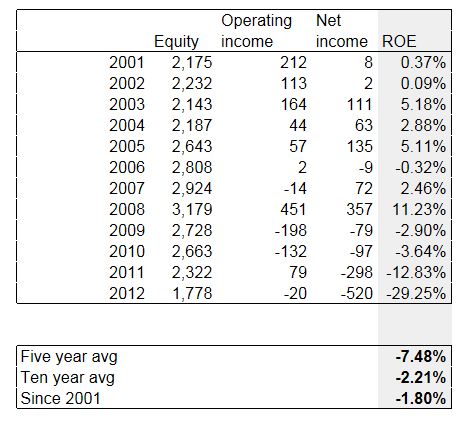
Sony Figures Excluding Financial Segment

How much would you pay for a business that has earned a -7.5% ROE over the past five years, -2.2% over the past ten and -1.8% since 2001?

And remember, this *includes* the profitable Pictures and Music segment.

Now you can sort of understand why Sony wouldn't want to spin off SFH.  What is left over afterward may not survive very long.

On the other hand, maybe the profitable SFH allowed SNE the luxury to do nothing over the years and have no sense of urgency or crisis.  If there wasn't SFH income to soften the income statement, maybe they would have more of a sense of urgency and do something drastic.

Obviously, since the movie and music segments too are profitable, selling those would only make SNE look much worse.  No wonder why they are in no rush to sell those businesses; they need the profits from the three good businesses to subsidize their bad businesses.

Total Liquidation
Judging from the above "stub" calculation, if you assume that the rest of SNE (other than the SFH, Pictures and Music segments) is worth nothing and you just sell everything and pay back short-term and long-term debt and the pension and accrued severence costs, you would be left with 500 yen per share; less than HALF of what SNE is trading at now.

But that assumes that you can shut down the rest of SNE at no cost, but that's not going to be true.  It would cost money to lay off workers (severence), shut factories, and there is no telling what the 1 trillion+ in product inventory is going to be worth.  I assume generally that current assets and liabilities fund each other (recievables versus payables, inventory versus trade payables etc...).

But in a liquidation, that is probably not going to be the case.

So at this point, I don't see any clear value for SNE as a whole, even though SOME of the parts or even many of the parts have great value.

Conclusion
So this is just a quick look, even though it took me a lot of time to go back and forth through all of these filings to figure some stuff out.  

I see that there is some great value here, but then there is a lot of debt too. 

It sort of does look hopeless to me, but I have no real view on the other parts of SNE's business.  I have no idea if Playstation 4 is going to come out and knock the X-box out of the game (like how Playstation put Sega out of business).  I have no idea if SNE's mobile phone business will do well against Apple.  I don't have a view on digital cameras, camcorders and things like that as I see it as increasingly commoditized.  This is the same with TV's and other AV products.

I get the sense that the Koreans are catching up much more quickly than the Japanese anticipated, and there really doesn't seem to be an answer for them.

Their computer business too, seems iffy to me. What is their edge? Can they do better than HP and Dell? How are they going to compete with Apple?

I would not be comfortable long this stock; there is just no clarity for me in how SNE can generate value here.  As I said above, just by looking at their ROE history, it's just not worth book.

Risk of Being Short
On the other hand, there is a lot of risk being short this down here.  One thing is that investors in Japan may look at book value as a valuation measure (I've seen it mentioned that way; that book value is fair value).  So positive sentiment in the Japanese stock market can take this stock up.

Also, foreign investors tend to buy SNE as a blue chip, core holding like IBM or Coke (well, actually I'm not sure but it sure does look like there are a lot of foreign owners). 

SNE has gotten hurt by the rapid rise in the yen, so a collapse in the yen that so many are calling for would lead to a big rally in all exporters in Japan regardless of 'real' future prospects.

And as we all know, in this world of technology, you just never know.  There was a time when people thought Sun Microsystems was dead (just before the internet boom and it made tons of money on that).  Of course, there is the Apple story and some others.

So a hit product or two can really change things but that's not something we can predict.

Anyway, at this point I think I will stay short this one for now.


Wednesday, January 11, 2012

Olympus, Nomura, Sony: What's Wrong with Japan

So we see every day why Japan has so much trouble getting out of it's long slump.  There was an article recently talking about how the lost decade in Japan is actually a myth, and that the reality is that Japan has done better than we all think since the bubble popped in 1990.  Yes, Japan has low unemployment, earnings are up and the economy avoided a depression, but that was done pretty much by government debt spending.

I wouldn't be too proud of that. 

Anyway, recent headlines further highlight the disfunction of corporate Japan.  We painfully realized how incompetent the government was in handling the earthquake and nuclear crisis last year and corporate Japan continues to shock us observers with truly bizarre developments.

Olympus sued current and former executives and directors for failing to deal with the fraud but strangely kept them on board.  Apparently, there is no support in Japan from shareholders to fire the board or replace the senior management.  How can this be?  It doesn't make any sense at all.  Woodford just gave up completely.  I don't know if he is the right guy or not, but the fact that there was no support for him in Japan and full support for current board and management is mind-boggling.

Nomura today also lost Jasjit Bhattal, the head of Nomura's global business apparently because Tokyo resisted Bhattal's call for deeper cuts in global operations (shutting unprofitable businesses, getting out of unprofitable countries etc...).  This is really bizarre too because I would think that more often, a head of a business would want to expand more than headquarters feels comfortable with and they leave.  Most bosses are empire-builders; they want to expand their empires, cost and risk be damned.  And Bhattal wanted to *shrink* and Tokyo said no, lol. Only in a Japanese company can this happen (?).

I have no idea if Bhattal is any good or not, but I get the sense that this is typical Japanese corporate mentality to resist change and resist firing people.  Also, Japanese are notoriously bad at cutting losses and admitting defeat (look at Olympus!).  They are also more concerned with market share and status than profitability (statements to the contrary notwithstanding).  You can be sure there are turf war issues too; intense lobbying by heads of unprofitable businesses to keep them going.

I don't know if this means that the Lehman purchase was a complete failure, but I bet that deep cuts would have been interpreted as such which probably scare the heck out of senior management in Tokyo.

Anyway, this is not a good development, I don't think. 

Nomura's legacy of failing internationally seems to be continuing and this might just be the latest iteration of it.

I still think for Nomura to realize value, they should focus on the domestic business and then eventually team up with a strong international bank.  Of course, this will never happen for the reasons I stated before.

Similar to this was the Sony comments that they will never exit the TV business because the engineers are very proud of their work.

I truly wish Japanese companies would really stop thinking this way and focus on profitability, returns on capital and things like that.  As Jack Welch says, firing people might be unpleasant and short term bad for the fired, but over the long haul it is good for everyone; the company (as they can cut cost and reduce the odds of bankruptcy which would be bad for everybody and reallocate resources to productive areas) , the fired employee (that can go out and find something that they can do productively instead of becoming corporate zombie employees like so many salarymen in Japan) and even the economy (as the newly unemployed find productive things to do including starting ventures.  Also more frequent firings would by necessity increase labor mobility).

Japan has a long, long way to go...   

*sigh*


Tuesday, November 22, 2011

The Problem with Sony


There was a decent article on Sony in Businessweek this week (read here). 

As I said before in another post, Sony is a company/stock that I would love to love.  I grew up with the brand and I think it still has a very strong presence in Japan and globally and does have strong brand value even though that seems to be eroding every year.

That's why I keep an eye on Sony and will keep watching it (maybe I will read their annual reports every year for fifty years and then finally buy some stock decades from now).  It also is a good window into corporate Japan because what ails Sony is not industry specific but more Japan culture specific.

The article lays out pretty well what has gone wrong at Sony over that past couple of decades.  I have no idea if they will recover or not and if I will ever buy their stock.

But there are some things that still bother me about it that keeps me away.  Actually, the fact that Sony is on the front cover of Businessweek with a negative headline ("What is Sony Now?") is a big BUY signal (the contrarian front page indicator).

The problem is how little progress Sony seems to be making even with a foreign CEO.  You would think things would change, but I guess Stringer is way too respectful of his collegues in Japan that he can't take drastic action.  What Sony needs, really, is a Lou Gerstner-like character (this name popped up in my mind because I just finished reading all of IBM's annual reports from 1994; fascinating reading).

Anyway, here's a a little snip from the Businessweek article that really shows what is wrong with corporate Japan.  I nearly fell out of my chair when I read this:


Stringer can't sell or dump the TV business because it's the Sony legacy?  Because everybody at Sony is very proud of the hardware they create?  Clearly, Stringer has been Japan-ized more than Sony has been Westernized.  Stringer doesn't want to hurt anyone's feelings.  Sigh.

A comment like that from a U.S. corporate CEO would be shocking.

I can imagine the internal lobbying, screaming, yelling and crying that must have happened when IBM decided to sell it's PC business (smart move).  I can also imagine what it must have been like with a hurricane of internal emails when GE tried to sell it's light bulb and appliance businesses.

You can't run a corporation on pride of past accomplishments.  Can you imagine where Intel would be today if they didn't decide to exit the commodity memory chip business?  

This is the sort of thing that really destroys corporate value.  I think CEOs and managers feel that they are doing the right thing for the long haul by not rocking the boat and preserving the legacy and protecting the 'pride' of employees but if there is no change when the world is changing the endgame is ultimate failure/bankruptcy.    It does nobody any good in the end to take the easy course and try to keep everyone happy (which is what it seems like Stringer is trying to do).

I used to be excited that Kazuo Hirai might become the next Sony CEO (Japanese executive with substantial overseas experience), but now I'm not so sure.  I think Sony really needs someone like Gerstner; someone from the outside with no emotional baggage and no internal political considerations.

Unfortunately, that is highly unlikely.


Tuesday, September 27, 2011

Sony

I recently read a comment that Japanese investors typically like to buy Sony stock at 0.7x or so book value per share (BPS).  That does sound a little cheap, so I took a quick look again, only to remind myself why I don't own too many Japanese stocks!

Sony really is a company that I would love to love.  I've known it as a kid and I have very positive memories associated with the Sony brand.  I am a big fan of Akio Morita and I grew up with the Sony walkman.

So this is a company whose stock I would love to own in a core portfolio for the long haul.  It's a solid, Japanese blue chip. 

But of course, you have to look at the business and not invest emotionally like that (that would be Howard Marks' first-level thinking!).  I decided to type this up because the same thing happens over and over in Japan as I still occasionally keep looking for interesting investment opportunities there.

Anyway, let's take a quick look at Sony.  The idea is that it is cheap on a P/B ratio basis.

The March 2011 annual report shows book value per share of 2,539 yen per share, and the closing price of the stock last night was 1,475 yen per share.   So Sony is not trading at 0.70x BPS, but a whoppingly cheap 0.58x BPS!

But wait a minute.  What difference does it make what the P/B ratio is if they don't make good money on that equity?  The standard measure for the attractiveness of a business is return on equity (ROE).

If a business can earn a nice ROE and you can buy that business at under BPS, that's a great combination:  Good business at an attractive price. 

So let's take a look at the ROE of Sony.  For reference, I also put the operating margin in the table.

Sony ROE and Operating Margin

                                     ROE                    Operating margin
2001                             13.60%                 1.80%
2002                               5.00%                 2.90%
2003                               3.80%                 1.80%
2004                               6.20%                 2.00%
2005                               4.10%                 3.00%
2006                               3.80%                 0.90%
2007                             10.80%                 5.40%
2008                              -3.10%                -2.90%
2009                              -1.40%                 0.40%
2010                              -9.40%                 2.80%
           
Five year average:            0.14%              1.32%
Ten year average:             3.34%              1.81%

This looks horrible.  The average ROE over the past ten years has been 3.34%, and over the last five was 0.14%.  Operating margins aren't much better.

Is a business that generates 3.34% return on equity attractive?  I think not at all.  Would I pay book value for such a business?  Of course not.  Would you pay a discount to it?   

Well, if you asssume they can do just as well as the last ten years and generate 3% ROE and you pay 0.6x book for it, that's an implied rate of return of 5%.  Not very exciting.  I would pass on this.

More worrisome is that in the last ten years, Sony was only able to achieve a double digit ROE in two years: 2001 and 2007.  I suppose 2001 was at the tail end of the internet stock bubble and boom times, and 2007 was also a boom time peak right before the housing collapse.

Now, if it takes the peak of a boom for SNE to make reasonable returns, that's not very encouraging.  I do remember 2007 being a flukishly good year for Sony.  I think they did well with the Playstation, large TVs, cameras etc...  U.S. and global consumers were spending like crazy.

And yet operating margin in that environment was only 5.4%.  Not so exciting. 

If those boom years didn't happen, then Sony's historical ROE would be even worse.

Every time I look at Sony, I wonder about the U.S. manufacturers of televisions, radios, stereo equipment etc... Where did they all go?  The Japanese basically took that market.

Is the same happening now in Japan?  Is Korea and China taking over those industries?  I think so.  Many Japanese used to tell me that there is no way that the Koreans and Chinese will catch up; that they don't have the technology to compete with the Japanese.  Ain't gonna happen.

But every single day, that becomes less and less true. 

At first, Sony lost a large block of business not just because of the Asians, but because the world went digital.  Their 'moat' or technological edge for a long time was in microelectronics etc...  They were able to make things smaller; smaller motors etc...

When the world went digital, all of that became useless.  This literally happened almost overnight.  And then Sony was late to enter the digital game (even though they do seem to have a large market share domestically in portable music players etc...).   But what is their 'edge' in the digital world?  All of that expertise they gained from manufacturing lost most of it's value.  Now you only need to wrap a chip with some plastic; no gears, tiny motors etc...

What about the Playstation?   It's also frightening to think that Sony's return on capital over the past decade includes some big business successes. 

The video game business is highly fluid.   Dominant players seem to change quite often, and the Apple iPod/iPhone and online PC gaming seems to be sort of a game changer.

In any case, I don't really have a deep understanding of each of Sony's business lines and I do acknowledge that this nominal, superficial cheapness will attract domestic and global investors to Sony and the stock price will probably go up when the global market stabilizes.

But from the simple above analysis, Sony really doens't look all that attractive.   I admit that I haven't picked apart Sony's balance sheet for mitigating factors to the above (for example, valuable holdings not earning returns on it's balance sheet, or hidden assets and other things), so there may be something else that makes Sony interesting.

For a long time, the Japanese stock market has seemed to be the most hated stock market in the world.  Of course, contrarians/value investors are always interested in looking where others don't.  I too have been interested in Japanese stocks for a long time for the same reason.

But time and again, every time you take a look at something, I realize why Japanese stocks haven't gone anywhere in decades.  Of course, the fact that it started at a ridiculous valuation in December 1989 accounts for much of the reason.   But the quality of the businesses from an equity shareholder point of view is just not attractive at all.  

No matter how cheap stocks look on a book value basis, it doesn't mean much unless the businesses can earn some decent ROE.