Showing posts with label MSFT. Show all posts

Thursday, November 15, 2018

BRK Corporate Governance, MSFT, Market Volatility etc.

So Buffett finally buys some JPM. He owned a bunch in his PA years ago and said it would be a conflict to own both JPM and WFC within BRK, or some such thing. I guess recent events (WFC scandals) have made him change his mind (as he may be starting to dump WFC). I've been a big fan of JPM for years, so naturally, I like this move. I wonder if Jamie Dimon would ever make it onto BRK's board; he would be a great fit there and would give the board some real, hands-on expertise in the financial industry (there is plenty of talent there, but noone with Dimon's experience/background).

This is the 13-F that was just filed (includes only positions over $1 billion):


Market Cap to GDP
Someone asked in a comment the other day what I thought about the market cap to GDP ratio, Buffett's once favorite stock market valuation indicator. This, like many other valuations measures, is really dependent on interest rates. If you believe (like I do) that interest rates drive the valuation of assets, then prices are high when rates are low and vice versa. So, of course, if interest rates are low, the market cap to GDP ratio will be high. But that tells us nothing about the valuation of asset prices as it has to be compared to interest rates. Plus, it doesn't really tell you anything about interest rates either. (A lot of bears like to point to 'overvalued' indicators, like this market cap to GDP, P/E, CAPE, EVITDA/EV, Dow-to-Gold ratio etc. But often, it's all the same thing, so it's like double counting. They all point to one thing: asset levels are high because interest rates are low. But, people still think of these above factors as separate, discrete pieces of evidence to show the market is overvalued.)

Not to mention, many U.S. companies are growing globally, so their sales and earnings from non-U.S. business will be capitalized in the U.S. stock market while the GDP will not include those new territories. If a U.S. company merges with a European company, the stock market valuation may well increase (while GDP does not). Also, when Yahoo owned Alibaba as Alibaba took off, the U.S. market cap of Yahoo (and therefore the U.S. stock market) increased (with no increase in GDP).

So in that sense, I don't think it's a relevant measure of anything these days. I still like to adjust interest rates to what we might think is a normalized rate, and then price assets off of that.

BRK Corporate Governance
Again, from the comment section, someone mentioned an analyst or author that is comparing BRK to fraudulent companies; BRK's corporate governance standard is comparable to historical frauds (ENR etc.).

Well, I am preaching to the choir here, and maybe I am just an ignorant, blind, cool-aid drinking BRK groupie, but every time I read these comments, I think it's ridiculous. It just takes a little bit of common sense to figure out the difference between BRK and the big corporate frauds in the past.

First of all, just for fun, I took a quick look at the corporate governance score of BRK on the Yahoo Finance page, and was surprised at the high score: 9 out of 10!
Corporate Governance
Berkshire Hathaway Inc.’s ISS Governance QualityScore as of November 1, 2018 is 9. The pillar scores are Audit: 1; Board: 10; Shareholder Rights: 8; Compensation: 6.
Corporate governance scores courtesy of Institutional Shareholder Services (ISS). Scores indicate decile rank relative to index or region. A decile score of 1 indicates lower governance risk, while a 10 indicates higher governance risk.
Not bad! But then, reading further, I realized that 10 means high risk, lol... Oops. So it is, in fact, the way I thought it would be. Just to be sure, I checked this at the ISS website.

From the ISS website:

THE METHODOLOGY BEHIND THE SCORES
Governance QualityScore uses a numeric, decile-based score that indicates a company’s governance risk relative to their index or region. A score in the 1st decile (QS:1) indicates relatively higher quality governance practices and relatively lower governance risk, and, conversely, a score in the 10th decile (QS:10) indicates relatively higher governance risk. Companies receive an overall QualityScore and a score for each of four categories: Board Structure, Compensation/ Remuneration, Shareholder Rights, and Audit & Risk Oversight.

WFC, by the way, with all it's scandals, has a QualityScore of 1.

Out of curiosity, I looked at MSFT and check this out: 
Microsoft Corporation’s ISS Governance QualityScore as of November 1, 2018 is 1. The pillar scores are Audit: 1; Board: 1; Shareholder Rights: 1; Compensation: 3.
Amazing!

MSFT
OK, and check this out from the proxy:
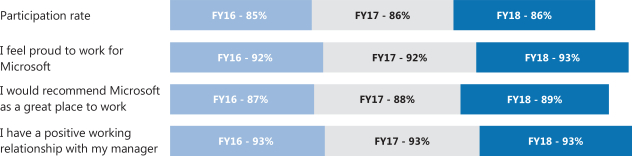
The vast majority of our global employees participate in an annual anonymous poll. Here is a selection of results:

LOGO


That sounds crazy too, for a large corporation. I don't know how 'real' this is, as we all know how people may be 'nudged' to fill out surveys in ways favorable to management. Well, they say it's anonymous, so OK, maybe it's legit. 

I have become in recent years a big fan of MSFT, both as a user and an investor.

My MSFT Experience
I have been tied to MSFT for most of my career as company PC networks were usually run on Microsoft and desktops were usually Windows NT or whatever. Of course, we also had Unix machines running the serious stuff, but most office work, spreadsheet work and whatnot were done on Windows machines. 

After going out on my own, I stuck to Windows, but I got increasingly frustrated at how often Windows would crash/freeze. Some days, I thought I spent more time waiting for things than actually doing any work. And then they killed XP (which I had on some of my old machines).

A programmer friend suggested I look at Linux, so I did. I installed Linux on my old laptop and eventually one of my old PC's, and I loved it. It was rock-solid and stable, like the Sun workstations (Unix) I used to work with that you never had to reboot or restart. I was seriously contemplating switching everything over to Linux and ditching MSFT altogether. 

One thing holding me back was that a lot apps written for Windows is not available in Linux (well, you can still run Windows apps with Wine, but I was a little skeptical/worried that there would be issues if there was another layer). Otherwise, I loved everything about Linux. I use GIMP now all the time for photo processing (like the Buffett photo in my last post), Libre Office is great and is getting better etc. Plus my Linux machines never just randomly go into these long updates. 

Well, one of my favorite things is how easy it is to run cron jobs in Linux versus Windows; I really hate the Windows task manager. A lot of other things are just so much easier to do off the command line in bash (although Powershell is getting pretty powerful, but it's so clumsy/clunky, I don't feel like learning how to use it properly). 

Back to Windows
But OK, I never abandoned Windows. But what sucked me back in and made me abandon the idea of switching over completely to Linux was Windows 10. I was skeptical, but upgraded all my Windows machines to Windows 10 (forgot when), and I have been very happy. Yes, if you are not careful and don't set your 'active' time, it can go into long update cycles rendering your computer unusable until the updates are done. This is forced so you can't stop it. But you can tell Windows what hours of the day you will not be using the machine, so the forced updates will happen in those inactive hours. 

OK, small problem. 

But since switching to Windows 10, I have had very, very few problems I used to have. Random crashing, random freezing etc. I have not had that occur much at all and it's been a pleasant surprise.

Also, Windows 10 comes with Ubuntu bash so if you like Linux command line stuff, you can do it all in a bash terminal right on the Windows 10 machine and in those drives/folders that Windows runs on (goodbye cygwin?!). 

The other major thing that drew me back to Windows is OneDrive. I used to do work on my home desktop and my laptop, and I used to have to email files back and forth to work on them. You can use Google Drive, Dropbox, Box etc. to sync files on your various machines, but I never got around to doing that with the above, and I didn't like how Google Drive seemed to keep altering my files (especially programs) when I uploaded them. 

But OneDrive was so easy and is basically already set up from the get-go in Windows 10. Now my most active folders are on OneDrive, I never have to worry about syncing anything; it's all done automatically.  

I think this is one of the big things that got me tied to Windows now. 

Plus, I am playing with Azure now and it is very easy to create Linux instances (basically virtual machines in the cloud) so you can write bots and set them up to run as cron jobs and your tasks will be done whether your PC/laptop is on or not. Plus they have databases and many other cloud services (I use Amazon too, but mostly for fun/experimenting). 


So when you think about how all of this is integrated and everything works great with each other, you can see how excited I am about MSFT. A programmer relative told me a few years ago that MSFT sucked for most of their existence, but that with C#, Azure and other cool things, they are becoming a really incredible company. (I am also experimenting with C# but haven't created anything for actual use). Of course, at the time, I didn't really look into it or understand. 

Anyway, this is sort of relevant, right? As IBM just bought Red Hat, which is a Linux business. Anyway, I still love Linux and have a Linux box sitting next to my main Windows 10 machine. Linux will continue to grow, and behind the scenes, Linux runs everything, and will run even more going forward.

And check this out. I just recently noticed that Stanley Druckenmiller is big into MSFT: 


So he is probably seeing and hearing the same things I am talking about. Well, OK, I have no idea why Druckenmiller is long MSFT. But I would assume it has something to do with what I'm talking about.

Oh yeah, and I really enjoyed Nadella's book: Hit Refresh.

With the FANG/FAANG stocks so popular, who knows, maybe MSFT is the tortoise that surprises everyone!


Back to BRK
OK, so there is probably not much I need to say on how silly it is to criticize BRK's corporate governance. Check this out from the BRK 2018 proxy: 


This list doesn't show a group of people who really need the money. I think the average compensation for a big company director is something close to $300,000. If you wonder why so many board members seem to be yes-men to the CEO, this may be one reason why; it's good money! Don't rock the boat, keep quiet and keep cashing your checks!

It's clear from the above table that BRK directors are not there for the money. And sure, they are friends with Buffett so are they really independent? I would rather have directors that understand Buffett and BRK well, and have enough of a spine to express themselves if they see something they don't like.

There is a lot more to say on this but one of the biggest arguments in support of BRK's structure is that Buffett himself is the largest shareholder of BRK, so if this was a fraud, who is he defrauding? Himself? That's laughable. He takes a $100,000 salary but the bulk of his wealth is created by BRK's stock.

This is the opposite of most situations, where managements own token amounts of stock (and dump their stocks whenever they exercise their options) and pay themselves massive amounts of money. When you own very little stock but pay yourself huge amounts, I think that incentivises fraud more. Don't you think?

When a CEO has 99% of their wealth tied up in a stock, that is stronger than any corporate governance factor I can think of.

But corporate governance specialists, critics and academics don't seem to understand that. They would rather check the boxes on what they inflexibly think of as good corporate governance practice and that's it. I guess part of it is laziness, and part of it is just practicality.

Institutions that own a large number of companies can't possibly evaluate that many CEOs, BODs, etc. so they need some simple measure to save time. Like P/E ratios, maybe. Those that don't know how to evaluate businesses may have to depend on P/E ratios to evaluate cheapness, but if you know how to evaluate businesses, P/E ratios often don't really matter (as they don't tell the whole story, like, in the case of BRK!). 

Abdication/Transparency
I mentioned this in the comments section of another post, but the other issue is that Buffett is so hands off the businesses to the point of abdication. But this is misleading. We all know Buffett watches numbers like a hawk. He said he gets faxed sales figures every day from various businesses and he looks at them carefully every day.

What he means when he says he is hands off is that he doesn't micromanage. He doesn't insist on seeing every ad before airing. He doesn't want to interview and approve every new hire. He is not going to approve every paint job of a store, or pricing/marketing strategy of each business. He is not going to approve each detail of every budget for every line of business.

But this doesn't mean that he isn't watching every penny that goes in and out of the businesses. We all know that all of the free cash of a business is sent to Omaha, so if something is wrong, he will know right away.

For the businesses where things may get funky, like the insurance businesses, those are highly regulated, and Buffett is very closely monitoring those businesses and is very involved as he says, with big blocks of business (talks to Jain several times a day etc...).

As for transparency, I don't know. I never thought BRK lacked transparency. It could disclose more, of course, but I never thought of BRK as a complete black box or anything like that. Major business lines are presented clearly and in detail. Some of the non-insurance businesses might be opaque, but each of them are just too small to disclose separately.

Some fuss is made about the Sokol incident, but those things will happen every now and then to any company. Goldman Sachs has a lot of legal and compliance infrastructure, is highly regulated and constantly audited, and yet we now have the 1MDB scandal. So I don't know that the Sokol incident proves anything about BRK either way. You have to look at the big picture and see the kinds of problems they've had over the years, and the record is pretty good. Will another scandal happen? Yes. These things will happen. It's how management deals with it that will determine the fate of BRK, and I have faith that they will deal with any issues in the future promptly.

As Munger says, it's all about incentives, and I think BRK people are properly incentivized.

Remember what Buffett said after the crisis. He said that there was a regulator who had one job, and that was to regulate FNM and FRE, I think. And they failed. So just because you have someone watching and regulating, if the incentives are not correct, you are going to have problems. 


Market Volatility
So, I was a little irked when the market was down 600 points the other day when I was on my way out of the house. I know I don't really care, but still, at the back of my mind, I think, is this it? Is this the end of capitalism? Are we going to go down 90% like we did in 1929-1932? OK, I wasn't that worried, actually.

But it made me curious. Why are we so scared of big market moves like this? 600 points is a little more than 2%. Back in the late 1980s and early 1990s, a 2% move would have been a 50 point move. 600 points is psychologically shocking because Black Monday was a 500 point drop. So it feels like Black Monday again (that was before my time!).

I tend to buy into narratives I don't really care about. The HFT/quants are making the markets more volatile. ETFs, especially leveraged ETFs are making the markets more volatile. More regulation in the markets and the resulting decrease in liquidity (thinner bid/ask from market-makers/specialists) are making the markets more volatile etc...

I go, hmm... OK. Probably true. But whatever. Doesn't matter to me.

But sometimes, I suddenly think, wait a minute. Is all of this true?!

Let's take a look!

First of all, let's just take a look at the market's volatility on a rolling 100-day basis. This is what derivatives traders would call the 100-day historical volatility. I looked at this going back to 1950. All of the following charts include data up to this past Monday (11/12/2018).


So, looks pretty normal. Even with the big moves in the past few weeks, nothing out of the ordinary here. In fact, I would have guessed things were pretty wild since Trump was elected, but if you look back to even 2012, 100-day vols have been in a normal range. It certainly doesn't feel that way.

OK, so maybe vols don't tell the whole story. Let's look at some other things.

We've had a few days where the market was down more than 2% recently. Or it feels like it happens a lot. So, I looked to see how often the market went down more than 2% on the day. To make it a readable chart, I just summed up how many times the market declined by more than 2% in the past 200 days.

Here's that chart:


So yes, it's a little elevated, but nothing really out of the ordinary. Look at the period during the crisis! Also, look at the mid to late 1990s, even before the bubble collapsed.

What about those days the market opens down 800 points and closes up 300, or some such crazy thing? It seems like that sort of thing happens a lot these days. If I had to guess, I would tell you that that happens more often these days than in the past.

To measure that, I just subtracted the day's high from the day's low and divided it by the day's close, and then took a 100-day average of that.

Here is that chart going back to 1962 (hi-lo data only goes back to 62):


...and surprisingly, this too is in a very normal range, and far below the levels of even the mid-90s (I guess the day traders used to make this really wide). Nothing out of the ordinary here.

And let's look at the number of days in the past 100 days that the day's range exceeded 2%. 


Totally normal range. Nothing out of the ordinary.

Conclusion
JPM is now a BRK stock. Get Jamie on the board! He would be the person I trust most next to Buffett.

BRK scores low on corporate governance, but so what? Look at the incentive structure, which is more important than committees, bureaucracies like compliance/legal departments etc.

People who write to complain about BRK are people who just don't understand, or just use BRK to grandstand and gain attention by making astounding claims against consensus (this is why people like to say "the market is going to crash 50%!", or "the market will get to 500,000!"). So ignore those people.

Microsoft is pretty awesome. I never made a post about it as an investment; I should have when I started to get interested, but oh well. Maybe eventually, but I don't really have anything to add to MSFT in terms of financial analysis/valuation.

And, the markets seem like they are crazy and more volatile than ever, but the above charts don't bear that out. People, the press, keep freaking out over 2% moves as if they are 10% moves. The markets, despite all the things that should make markets more volatile than ever, are just as volatile as they ever were and no more.  So relax! 

Wednesday, July 9, 2014

Cost Cutting, R&D etc.

This is going to be a wandering post, just thinking out loud about a few things that have been on my mind.  I've been posting about "outsider" CEO's and now about 3G Capital.  They of course have a lot in common, but one thing is that these acquisitive CEO's cut costs, and sometimes a lot.  And this obviously raises questions about the sustainability of the business model.

This also ties in with the current Valeant / Allergan drama which I haven't posted about yet.  The bearish view is that Valeant's business model is unsustainable.

Many say the same thing about other cost cutters.  Popular examples would be Sears Holdings and Hewlett Packard.  The consensus seems to be that Lampert cut investments so deeply that it has destroyed Sears Holdings, and Mark Hurd cut R&D so deeply at Hewlett Packard that he destroyed the business.

I'm sure there is some truth in both.  When I used to go to K-mart at Astor Place in NYC, the elevator would make a scary, grinding sound.  I only rode it when I had to and it only went from the first floor to the basement; I would not have ridden an elevator that sounded like that to a high floor.  (I actually love that K-mart.  Since we don't have a Walmart or Target in Manhattan, it's great for cheap things you might need.)

And every time I walk into a Sears it was really a sad sight.  I actually really liked the kid's clothes at Sears.  I thought it was good stuff for the really low prices.  But I could get the same sort of thing at Target, Old Navy, Children's Place and many other places (so why would I go all the way to Sears just for that?).

But on the other hand, I'm not too sure more capex to make the stores look nicer would have made much of a difference.  Sears seems to have clearly lost business in their respective categories to Home Depot / Lowes, Best Buy etc.  And K-mart is just losing out to Walmart, Target and now the dollar stores.  Capex doesn't seem to me (and never did) to be the answer, really.   A nicer look wouldn't make me want to go to Sears versus Lowes.  They are just suffering from a much deeper existential problem.

Hewlett Packard too may be undergoing similar pressures; they could have pumped more money into R&D, but to achieve what?

This got me curious about what many consider the most innovative company on the planet:

Apple (AAPL)
So, let's take a look at AAPL.  Just out of curiosity, I looked at AAPL's sales and R&D since 1992.   Steve Jobs came back to AAPL in 1997, the iPod was launched in 2001, the iPhone hit the market in 2007 and the iPad came out in 2010.

Surely, Jobs must have come back to AAPL and boosted R&D and spent billions (like other tech companies) to create such great products.

Let's take a look:

Apple R&D History

What is stunning here is that AAPL spent an average $610 million per year in R&D between 1992 - 1996.  Jobs came back in 1997, and between 1997 through 2001 when the iPod was launched, R&D averaged only $382 million, 40% less than previous management!  OK, so the iPhone is really what shook the world.  Between 1997 and 2007 when the iPhone came out, R&D averaged $486 million per year, still 20% less than the previous management.  In terms of percentage of sales, previous management spent 6.9% of sales on R&D, and Jobs spent 5.6% over the following ten years until the iPhone came out.

If you only looked at the numbers, you might have been horrified.  My gosh, you would say.  AAPL is so "has been" that they should be boosting R&D, not cutting it!  This is a disaster in the making!

At the time, one of the most innovative companies was Nokia, so let's just look at what their figures looked like around the peak.  In 2013, they sold the phone business to Microsoft so I left out 2013.


Nokia R&D History

So these guys, the most innovative company in the world at the time, were spending between four to six billion euros per year on R&D, and double digits as a percentage of sales.   Nokia was spending more than ten times as much on R&D as AAPL.

OK, so this is an exception you say.  These disruptive innovations are always like this and they are unpredictable.  Jobs is also a special case; a super-genius, so we can't use this as a standard for anything.

This is also true.   But this would reinforce my doubts about AAPL's long term future (I have no position, but my view hasn't changed since the series of posts I made about AAPL in the past). If Jobs was able to create so much and change the world with less than $500 million per year in R&D, what are they coming up with now spending ten times that amount every year?!  Does AAPL now have the big company disease?

Other Companies
Being curious, I took a look at a bunch of other companies considered innovative (and not), and some others that are known for spending a lot on R&D:

                             Sales         R&D      R&D%
MSFT                   $77.8        $10.4       13.4%
AAPL                 $170.9        $ 4.5         2.6%
Samsung             $201.1       $11.5          5.7%   (converted at 1000 KRS/$, 2012)
GOOG                  $55.5         $8.0        14.4%
IBM                      $99.8         $6.2          6.2%
HPQ                    $112.3        $3.1           2.8%
INTC                     $52.7      $10.6         20.1%
Sony                      $45.2        $4.7         10.3% (converted at 100 yen/$, sales exclude financials, film                                                                              and music)
Nintendo                 $5.7        $0.7         12.5%

BA                        $86.6        $3.1           3.6%
GM                     $155.4        $7.2           4.6%
Toyota                $256.9        $9.1           3.6%  (converted at 100 yen/$)
Honda                 $118.4        $6.3          5.4%  (converted at 100 yen/$)

So there are some surprises here.  MSFT is spending $10 billion per year on R&D, or 13.4% of sales.  You wonder where that money is going given their lack of innovation.  Sure, there is some stuff going on; incremental improvements etc.  But nothing really exciting.  And that's after spending $10 billion per year?  Again, maybe it's not fair but it's stunning what AAPL was able to achieve with less than $500 million per year.

Sony too spends $5 billion per year, and the iPod should have been their product.  GoPro too came out of nowhere and that's exactly the sort of product Sony would have come up with back in the 1970's and 1980's when Akio Morita was still running the place.

GOOG spends a lot, and who knows where that goes.  We know they are working on all sorts of things; Google Glass, driverless cars etc.

Owner-Operator Tangent
This AAPL and Sony talk gets me off on a tangent.  What's really interesting is that AAPL created the products that Morita would have no doubt created.  Why was Sony not able to?  There have been a bunch of books on the topic, but at the end of the day, I just think that true innovation is hard with non-founder-owners  (I use the term owner-operator, but I actually mean founder-owner).  Sony, like MSFT, had certain businesses to protect too; AV business that would have become obsolete due to digitization (which happened anyway!) etc...

(Which makes me wonder, how much of MSFT's $10 billion is actually spent on creating new things versus trying to protect the Windows business?  Imagine buggy manufacturers, upon seeing the automobile on the horizon,  investing massively in R&D for horse feed that might increase the speed of horses.  Is that what MSFT is doing?)

I read a few books written by Tadashi Yanai, the amazing CEO of Fast Retailing (which runs the Uniqlo stores).  At one point in 2002, he retired and handed off the CEO-ship to someone he thought was perfect for the part; he understood the culture and what drove Uniqlo's success, was smart, ambitious and hard-working.

But it didn't work out.  Why?  Yanai said that the new CEO set a modest growth target and got too comfortable.  He didn't want to take risk and make drastic actions to further the success of Uniqlo; he wanted to protect what was there and grow modestly with low risk.  This turned out to be a disaster for Uniqlo and Yanai had to come back.

Maybe it was a similar story with Howard Schultz and Starbucks.  He also retired once and had to come back.

This is what worries me about the generation directly after the founder/owner.  A founder/owner will take big risk and take bold actions because he can.  Employees can't complain.  He is the star.  Shareholders can't complain.  Suppliers, vendors and customers can't complain.   They are all there thanks to this one individual (well, OK, it's all teamwork.  But there is usually that one person that attracts the team).

But when a non-founder / non-owner takes over, they can't afford to upset people.  They can't take bold actions and take big risks because if they fail, it can be catastrophic.  They tend to work to maintain the status quo, or work for modest growth and improvement.

(This is something to think about too with Berkshire Hathaway, by the way.  Buffett can afford to take bold actions and goof up since he has so much goodwill (and cumulative performance) built up over the years that even a humongous blunder (unless it destroys BRK completely) will probably be forgiven.  Not so the next CEO.)

This, by the way, is why I think Samsung was able to give AAPL a run for it's money while Sony is nowhere on the map:  Samsung is still (or was until recently) founder-run and Sony is not.

A really great book written by a founder is:  Creativity, Inc: Overcoming the Unseen Forces That Stand in the Way of True Inspiration.   Catmull is really honest and discloses a surprising amount of stuff about Pixar in the book.  I guess only Catmull or one of the other co-founders would be allowed to disclose so much.  But reading this book, it makes you realize how hard it is to create and maintain a culture even when the founders are still there.  This makes it feel like it will be very hard to keep up the winning streak without Catmull, Lasseter, Stanton etc.


Other Innovative Companies
We can look at Facebook, Twitter, GoPro and many others; they were created with very little capital. But it's not fair to say that the cost of creating Facebook was a laptop, an internet connection and a college student.  For every Facebook, there are many others who try to follow in the footsteps of Michael Dell, Bill Gates, Steve Jobs, and most fail.  So the actual cost of creating a Facebook is much higher than that.

I suppose we can argue that that is the case with the recent AAPL too, that Steve Jobs is a special case.  Very few people change the world multiple times.   So Jobs can work wonders with $500 million and most others can't.  But does that mean they can with $5 billion?   If they can't do something with $500 million, why should we think they can do it with $5 billion?

Valeant, Allergan, Yahoo
So it makes me wonder, maybe Michael Pearson is right.  He has been in the business a long time and has seen a broad view of the pharmaceutical industry as a consultant so probably really understands the waste that goes on in R&D.   And his idea is to just spend R&D where it matters; go for the high probability bets like line extensions or alternative uses and forget about the shotgun approach that seems to be common in the industry (not sure if that's still the case but I think it used to be; just do everything and see what sticks).

And perhaps purchasing products via M&A is more efficient than spending a ton on R&D.

Which reminds me that Yahoo's best investments have been Yahoo Japan and Alibaba.  I suppose they could have spent the same money in R&D or marketing.

Masayoshi Son of Softbank is like that too; he has made some great bets over the years.  I've never owned Softbank or any of his entities only because he is just too far out for me.  He told Charlie Rose not too long ago that his stock price went down 99% but bounced back quite a bit.

Well, I tell people don't worry about stock price volatility and who cares what happens to the stock price as long as intrinsic value is growing.  But a 99% decline, however temporary, even for me, is too much.  We all have our limits, I suppose.

Does R&D Have to be Constant? 
Back to the subject of R&D.  I wonder if R&D has to be constant.  Ackman pointed out that Allergan actually pays the CEO to spend money on R&D. I think that is to deter a CEO from slashing R&D dramatically to boost profits to collect a bonus.  So it makes sense at some level.  But it also reduces the incentive to make R&D more efficient.  It's sort of the opposite of zero-based budgeting; they know R&D will not be cut regardless, because it can't be cut by contract.  Is that really the way to run a business?

What would happen if all of the R&D in every company was subject to zero-based budgeting?  Every year, you would have to justify every dollar of expense in R&D; why it is needed, the probability of success and potential return etc.

Unfortunately, for competitive reasons we shareholders really can't demand details on R&D spending.  But I guess we can demand more disclosure as to how efficient or useful the R&D actually is.  What the heck is MSFT spending $10 billion on?!  NASA (actually, a panel that includes NASA) says that they can get people to Mars with $80-100 billion in 20 years.  That's $4-5 billion per year to get a manned mission to Mars!   What's MSFT gonna do with twice that?!

In a lot of companies, particularly high margin companies, it may be that they spend on R&D because they can.  Their margins are high enough that even if they spend a ton on R&D, their margins would still be higher than anyone else, so why not spend and see what will come out of it?

Other Costs
So I looked at R&D and innovation (well, not really;  I just looked at some raw numbers), but the same argument applies to all other costs.  Just because you cut cost doesn't mean you are hurting the business, and just because you spend more doesn't mean you are improving the business.  It all depends on what the costs are for.  Is the cost really essential, or is it there because the business can afford it?  In companies, people constantly need to be promoted so organizations tend to get bigger and bigger.

The guys at 3G Capital have been doing this sort of thing for years (as have, for example, the folks at Danaher) so they understand this very well and obviously have a good grasp of what sort of costs can be cut and which can't.

Even though I have no proof, I tend to believe that more businesses go out of business or suffer due to lack of cost controls (complacency) rather than too much cost cutting (which no doubt occurs too).

Conclusion
Well, there's really no conclusion in this post.  Just more questions.  I've worked in a big company and understand the resistance to change.  Whenever we are asked to cut costs, all hell breaks loose and people fear that all sorts of bad things will happen.

Well, I did experience one bad cost-cutting drive.  A company I worked for hired an efficiency expert and all hell did break loose.  Suddenly there were no more paper towels, toilet paper or soap in the bathrooms and the hallways went dark as there were no more light bulbs.  A bunch of other problems popped up, and it turns out that this efficiency expert was paid a percentage of total costs saved.  Duh.   So this guy basically just cut everything he had an authority to cut and I think walked away with a nice bonus (or he may have gotten fired before collecting for cause, but I don't even know;either way he wasn't around for too long).

As it says in the Fifer book, the trick is to cut costs that don't add to business and increase spending on what does.  It's not about cutting cost across the board.

The problem with middle management is that when someone is in charge of a section or division, it's a rare manager that will work hard to shrink it.  Most people want to expand their divisions regardless of whether it's a profit center or cost center.   When you go to a budget meeting, who the heck goes, "I want my budget cut 10% next year!".

Sorry for the long, meandering post.  Eventually this will turn into an idea and a more cohesive post.


Tuesday, March 18, 2014

Greenblatt on CNBC: Market Reasonably Valued

So Joel Greenblatt was just on CNBC and said some interesting things.  I don't intend to post every time someone I respect shows up on TV, but this appearance was especially interesting to me for a couple of reasons.  One major reason is, of course, market valuation.

I don't really care about the many folks that call for a crash or call the market overvalued and whatnot, as many of those people have no track record of turning their market views into long term profits.  If you think about the guys that show up on TV as bears most of the time in the past ten or twenty years, most of them don't have good long term track records.

But the other day, Seth Klarman was reported to have been pretty bearish saying that there is an impending asset price bubble (in his letter to investors).  It's true that he has been cautious since the 1980's (and yet still manages to make a lot of money year after year), but still, his recent warning is not to be taken lightly.

On the other hand, Warren Buffett has said recently that the market remains in the "zone of reasonableness" or some such.  He doesn't feel that the market is particularly overvalued but not especially cheap.

And then of course there is the Robert Shiller P/E ratio (CAPE) that shows serious overvaluation.

What are we to make of all of this?  I have posted in the past about market valuation, but since it seems to be such a hot topic again now, I thought Greenblatt's input on this would be interesting.  He is one of my favorite investor/authors so I do take what he says seriously.

Here is the link to his appearance:  CNBC Greenblatt video

Anyway, this is what he said:

What he likes
Hewlett Packard (HPQ) and Apple (AAPL).  They trade very low on measures of free cash flow with "huge return-on-capital businesses".  Most people don't like them because they're old and stodgy (referring to HPQ).

AAPL
This is one of the parts that was really interesting to me.  I always wondered why Greenblatt liked Apple.  If you look at Greenblatt as the author of "You Can Be a Stock Market Genius", it doesn't make a whole lot of sense.  The future of Apple is hard to predict; it doesn't pass the five or ten year test of what the business will look like etc.

Greenblatt explained that when there is a business with a lot of change, where the technology changes, competition changes and you don't even know what the company will be selling three or four years from now, he tells students to skip it and find something they can figure out.

But if you buy these businesses at such low valuations as a group, then you can do well.  You don't buy one Apple, you buy a basket of Apples.  And when you buy a basket at such low valuations, it's good.  This bucket of technology stocks is cheap.  He later mentions Microsoft (MSFT) as also one of the large, cheap tech stocks.

So now I understand that this is the author of "The Little Book That Beats the Market" talking.  He doesn't know or understand the future of Apple, but he is confident that a basket of tech stocks trading so cheaply will do well going forward.  He has no view on the sort of things we talked about here regarding AAPL.  I should have known that since every recommendation he has made on TV since the Little Book was published were basically magic formula stocks.

Large Caps Reasonable
Greenblatt said that looking back over the past several decades, the Russell 1000 index is trading at the 42nd percentile in terms of valuation; the index has been cheaper 58% of the time over the past several decades.   So it is reasonable.  His data shows that from here, the one year forward returns is somewhere between 7-12%.  That's not bad. 

Small Caps Not
He said that the Russell 2000 index tells a "very different story".  That index is in the top 5 percentile of valuation, meaning it has been cheaper 95% of the time in the past several decades.  The one year forward return from this level is a negative 3%. 

Super-Large Caps Reasonable
He said that the top 20 names in the S&P 500 index, which is 30% of the index by weighting, are reasonably priced, even Google (GOOG).

What Do I think?
So this is all very interesting.  You have some of the smartest investors saying all sorts of things about the market and not in agreement.  Klarman said that on almost any metric, the market is "quite expensive", and that a "skeptic would have to be blind not to see bubbles inflating..."

And yet we have Buffett pretty mellow about it all, still buying stocks and his underlings still buying and Greenblatt saying things are reasonable.

I personally don't spend too much time on this stuff.  I would rather spend time on bottom up and not worry too much about the top down.

For example, of all the posts I've made about investment ideas, the overall market doesn't really make a difference to me.  I wouldn't say that JPM is attractive here only because the market p/e is 20x or some such.  I like what I talk about here pretty much on an absolute basis.  Of course, if the market was really overvalued at 30-40x p/e, then I would like my ideas more (at the current valuation), and if the market was trading at 7x p/e, then I would probably like the market more.   But those are extremes on both ends.

I think the key is what Buffett said in the annual letter.  If you own a business that you like that is a good business run by good people and is reasonably valued, why sell it just because some people think the overall market is overvalued?  (Well, Buffett talks about macro factors, but I think the same applies to overall market valuation; why sell your business you like just because something else is overvalued?).

Identifying the market as overvalued and undervalued is fun stuff, but it is really hard to turn into long term profit.  You can always guess one or two turns.  You will always run into the guy that sold everything in August 1987 or early 2007.  You may even run into folks that got out in August 1987 and then got back in in December 1987, or got out in 2007 and got back in in early 2009.  But you really won't find people who did that over several cycles.

In my previous life, I read just about every investment newsletter (of course courtesy of my employer), followed every guru and nobody calls the market continuously through cycles, even using rational, simple tools such as valuation.

Even recently, there is one prominent strategist that is a good read, but this strategist jumped in and bought gold just about at the top of the market.  Another fund manager/economist who writes an interesting, well-written, convincing and widely-read newsletter has performed horribly over the long term.  Yes, maybe the market is toppy so the fund looks the worst now (just as value investors look really bad at bear market lows), but I don't think losing money is really acceptable for something that is not supposed to be a bear fund (it's supposed to be hedged, which is not the same thing).

Klarman has been cautious for a very long time but still manages to make money, so that's a bit different (and rare!).

I've talked about how Greenblatt and the Superinvestors of Graham and Doddsville made money over time (see here), not to mention Warren Buffett.  These guys didn't do it by getting in and out of the market based on market p/e, market cap to GDP, CAPE or anything else that I know of.

So What to Do?
So for stockpickers, just look at your stocks and if you like the business and where it is valued, who cares about the market?

What about folks invested in the S&P 500 index?  Well, Greenblatt did say that the 20 largest names in the index are reasonably valued, so the index should be fine to own.

Even if Greenblatt didn't say that, the stock market overall returned 10%/year or so historically, and that was only achieved by owning the index during good times, bad times, when they were cheap and when they were expensive.  10% was not achieved by getting in when they were cheap and sitting out the market when it was expensive.

If the market is expensive, the correct thing to do is not to sell out, but to adjust your expectations.  Greenblatt did say something like that; if the market typically earns 8-10%/year and it's a little overvalued now, then the returns will be a little lower, but still good.

I think the mistake is that when markets are overvalued, people think that it then must go down.   So they take a short position or buy puts.   Or they get out completely and wait to get back in cheaper.

Maybe the correct way to look at it is that when markets are higher we should expect lower returns going forward and that's that.  To assume that when markets are expensive, that we can sell out now and get back in cheaper later is a risky assumption, and one that hasn't worked out over time (again, show me someone who has done that successfully over many cycles!).


Tuesday, November 15, 2011

Harold!

That's the hint Warren Buffett offered to CNBC Monday morning when he said he will tell viewers which stock he has been buying this year.  None of the CNBC folks were able to guess (I had no idea) what stock it was. 

Harold's short name is Hal, of course, and Hal is the computer in the movie "Space Odyssey"; the letters following each of H-A-L are I-B-M.

This is a surprise on many fronts.  For many years, Buffett spoke of not wanting to invest in technology because it's hard to know what the industry will look like in five, ten, or twenty years.  Buffett really does continue to surprise. 

He always talked about how he doesn't like capital intensive businesses but then bought Mid-American, a capital intensive, regulated utility.  He also bought Burlington Northern more recently, both capital intensive and cyclical.  He has spoken about derivatives as weapons of mass destruction and then wrote $34 billion in notional amount of global stock index put options.  He speaks up against investment banks and then buys a large stake in Goldman Sachs (via preferred shares with warrants).

Now, after years of avoiding technology, he makes his largest public equity purchase ever and buys IBM.  What is great about Buffett is that he evolves.

Anyway, let's take a quick look at this.

Big Bet: Focus / Concentration
Buffett bought 64 million shares for $10.7 billion, starting in March of this year.  That's a huge buy.  To see how big it is, take a look at these figures.

as of September 2011:
Berkshire Hathaway Shareholder's Equity:   $160 billion
Stock holdings at Market:                              $67 billion

So he made a purchase that was 6.7% of the total net worth of Berkshire, and 16% of it's entire stock portfolio.  Now, that's focused investing.  How many people put 16% of their stocks into a single idea?

For reference, here is Berkshire's largest equity holdings as of December 2010:


If you look at the "cost" column here, you will see that this $10.7 billion purchase of IBM stock is the largest purchase ever for Berkshire.  After IBM, the next largest purchase is $8 billion in Wells Fargo and after that, nothing even comes close.  Kraft Foods comes in at $3.2 billion.

Of course, this table only includes stocks that BRK still owns, and not ones that were sold or were taken over completely (like GEICO, Burlington Northern, Gen Re etc...).

But still, there's no question this is a big purchase.   Only Coca-Cola would be worth more at this point than IBM.  Even the companies that he really likes, like Walmart, Procter & Gamble, Johnson and Johnson and others come in at only $2-3 billion.  Wow.

Reading Annual Reports
The other striking thing about this is that Buffett was triggered to move on IBM after reading the 2010 annual report in early March.  He said he read the report, did some work on it and then started buying in late March.

What is amazing is that he said he has been reading IBM annual reports every year for the past 50 years.  He said the same thing when he bought Annheuser-Busch too.  So even though Buffett wasn't interested in technology and thought he'd never buy tech company stocks, he kept reading IBM annual reports every single year anyway.  *This* is why he has such a strong understanding of business and good feel of the stock market.  This is why he is such a great investor.  Can you imagine the information stored in his head from reading tons of annual reports over the decades?  Even of stocks you never bought or thought of buying?  Incredible.

(Not to belabor the point, but next time you talk to someone who has lost money (or keeps losing money) in the stock market and blames the market, Wall Street or anything else, ask them how many annual reports they have read in the past month, year, lifetime?)

Due Diligence/ BRK Advantage
The other thing that struck me was yet again how BRK being a large conglomerate can be a big advantage.  I keep saying that Buffett may not be an economist and his predictions may be no better than anyone else, but with so many businesses reporting to him on a daily basis, he has a real time finger on the 'pulse' of the economy so he knows what's going on.  He doesn't have to wait for government statistics and he doesn't have to plug them into econometric models or comments/predictions from economists.  He knows what is going on every single day.

And here, for kicking the tires on IBM, he researched IBM's competitive position by asking all his companies about their IT.  He realized how sticky IBM really is and entrenched in corporate IT systems (and high cost of switching out), and how businesses will have to rely on IBM more over time as the need to process information increases.

He realized, apparently, that IBM is not your typical tech stocks subject to changing trends.  It would be very difficult to displace IBM with their strong position, much stronger than say a software company that writes limited applications and things like that.

Buying at the Highs
As usual, people focus on superficial things like the nominal stock price.  But IBM is trading at it's all time highs, they say.  It's not cheap.  These people would rather buy a crappy stock on their lows, like airline stocks in front of bankruptcy.  A good stock is a good stock because it's a great business trading at a decent valuation.  It doesn't matter if the stock is at an all-time high or low.

Of course, we value investors typically like to look for things on the new lows list to see if there are any babies in the bathwater, but Buffett has since been more interested in paying fair prices for great businesses rather than great prices for fair businesses (or something to that effect; I'll never get these things exactly right).

Some people analogize this to his Coca-Cola (KO) purchase too, which from a value investor standpoint wasn't a 'cheap' price nor was it on the new low list.  But it has done tremendously well.  I think people do tend to overemphasize this 'nominal' price.  This, by the way, extends to the overall market too.  Some only want to buy stocks during panic periods, like in early 2009 and think it's not a good time to buy stocks otherwise.  However, the KO purchase was not done at a depressed valuation for either KO or the stock market, and yet it is one of Buffett's biggest winners.

His Burlington Northern purchase also was at a high and the valuation was not even that attractive (I think 20x p/e or some such), and yet this holding (now completely owned by BRK so no market price) has been estimated to be worth 30 or 40% more than the acquisition price already (looking at earnings growth and using multiples of other listed railroad stocks).   A huge winner already.


IBM
So what's so great about IBM?  Buffett was impressed with the management even though he couldn't even pronounce the CEO's name (he said, "Palmi...", looked uncertainly at Quick who said "Palmisano").  He has been reading the annuals for years and was impressed with the change that they have undergone recently.  He said he was impressed by how they outlined exactly what they were going to do five years ago and achieved it. 

He said the 2010 annual report really details why he likes the company so much, and he can't think of any other management team that has laid out a roadmap with so much detail/specifics on exactly what they are going to do.  They did this before five years ago and achieved it so he feels they will continue to be able to meet their plans.

IBM 2010 Annual Report
OK, so what's the big deal about the 2010 annual report?  I took a quick look and here are some notes.

From the letter to shareholders:
Since 2002, IBM has:
  • added $14 billion in pretax profit base to IBM
  • Increased pretax income 3.4x and EPS 4.7x and free cash flow 2.8x
  • had cumulative free cash flow of $96 billion
  • Gross margins improved 9.4 points to 46.1%
  • Pretax margin improvement to 19.7%
  • 90% of profits in 2010 from software, services and financing

In 2010,
  • Earned EPS of $11.52, up 15% for eight consecutive years of double digit growth (revenues were up +4%, pretax income +9%)
  • Free cash flow was $16.3 billion
  • Use of cash in 2010 was $6 billion in acquisitions, $4 billion in net capex, returned $18 billion to stockholders via $15.4 billion in share repurchases and $3.2 billion in dividends.

Over the past decade, IBM has returned $107 billion to shareholders through dividends and share repurchases after $70 billion in capex and $60 billion in R&D.   They also earned free cash flow of $109 billion, tripled software profits and increased share of revenues from growth markets to 21% from 11%.


In 2006, IBM introduced the Road Map 2010.  In this, one of the goals was for EPS of $10-11/share by 2010 (they achieved $11.52).

For the 2015 Road Map IBM expects $50 billion in share repurchases and $20 billion in dividends to be paid out.

Over the next five years through 2015, IBM will:
  • earn at last $20/share in EPS
  • generate $100 billion in free cash
  • return $70 billion to shareholders
  • grow revenues from growth markets to 30% (from 21% in 2010)

 Over the past ten years, free cash flow was $109 billion and $107 billion of that was returned to shareholders so we know that IBM is shareholder friendly.  Also, net income over those years were $95.6 billion so net income may be a conservative proxy for free cash flow so looking at the p/e ratio won't lead you too far off course here.  (In other words, they really do earn their EPS and they do convert that to distributable/returnable cash, and then they actually do return it to shareholders! This is very unlike other companies that put up positive accounting earnings but generate no cash, or even if they do, spend it unwisely and destroy shareholder value.)

So having said that, what is IBM worth?  What does Buffett see?  His average purchase price, he said, is $170/share.

That comes to 14.8x last year's earnings, 12.7x current year and 11.4x next year's earnings estimates.  That's pretty cheap for a company that plans to grow EPS by 11%/year (to at least $20/share by 2015), and that has grown 10%/year over the past ten years. 

(Yahoo finance earnings estimates for IBM were: 
  12/2011:  $13.38
  12/2012:  $14.85)

Even at the current price of $189/share, it is trading at  14.1x this year and 12.7x next year's estimate.

Buffett wouldn't have bought IBM if he thought IBM's competitive position would decay over the next few years.  If this is true, then IBM should manage at least a market multiple as their growth prospects are better than the average company. 

Given management's $20/share EPS target by 2015 (this is a low-end target as they say they will earn at least $20) and putting a 15 P/E multiple on that gives a target price of $300/share for IBM.

Buying it now at $189/share gives a return of 12% or so per year by 2015, not bad at all.

Should We Follow Buffett Into IBM?
In general, you can't really go wrong copying Buffett's stock buys.  He knows more about businesses and stocks than most others and his decisions will obviously be superior to others.

So for those looking for large, blue chip companies that they can own for a long time, I would recommend IBM and other BRK holdings for sure.

What's great about recent purchases is that the prices are still pretty close to where Buffett bought it, and the circumstances is going to be the same; fundamentals haven't changed much over the year.

This may not necessarily be true for Buffett's other holdings.  For example, people followed Buffett into Coca-Cola back in the late 90s calling it a Buffett stock, but they paid 40-50x P/E.  This did not turn out well for them (Buffett paid way lower prices back in the late 80s).

Buffett would not pay 40x P/E, even for Coke.   

Finding the right stock is only part of the equation.  A good price is the other side, and this is trickier to determine for Buffett's longtime holdings (again, since they may be overvalued at any given point in time).

Buffett put $10 billion+ of fresh BRK capital into IBM at these prices, so that's a different story than trying to figure out whether the other holdings are good buys now or not.

Having said that, for full-time investors and pros, IBM is not going to be the most attractive investment.  BRK can only buy stocks in the largest corporations in the world.  This reduces his universe dramatically from what is available to everyone else.  There are thousands of companies listed in the U.S. (actually, probably tens of thousands).

Joel Greenblatt, in a speech a while ago, recommended to investors, don't invest like you're managing $10 billion.  That means to go look for other opportunities where big players can't look (smaller cap stocks).

Anyway, I haven't even really dug into the IBM annual report for 2010 (10K etc...) so don't really have a good feel of the business.  I will take a look at it and may post an update if I find interesting things to say about it.

And a By the Way About Microsoft (and Intel)
Some people might have been surprised that Buffett bought IBM and not Microsoft (MSFT) given the cheapness of MSFT versus IBM and his close friendship and presumably good understanding of MSFT's business and future.

Buffett did say in the CNBC interview that he or anyone at BRK will never buy MSFT because he is just too close to Bill Gates.  If he or anyone at BRK (including the two new investment manager hires he told that MSFT was off limits) buys MSFT and then there is a positive development at the company, nobody would believe that Buffett didn't have inside knowledge of such development.  He also did say that it was an attractive stock.

Todd Combs, one of Buffett's two new investment management hires also bought a bunch of Intel stock (INTC) according to the latest filing.  This is also very interesting.

The argument against Microsoft and Intel is quite simply that the Wintel era is over and PC's are dead.  This is why we aren't supposed to like these companies even if they are cheap.  The suggestion is that these are value traps.

Perhaps they are.  I actually don't have a strong view on the future of PC's.  But I am inclined to think that maybe assuming the PC era is over and MSFT and INTC are not interesting investments may go into what Howard Marks calls "first level thinking" and not "second level thinking".  (Speaking of which, it wasn't too long ago that IBM was supposed to be dead because the PC was going to kill their mainframe business).

Anyway, Buffett's comment on the attractiveness of MSFT and Comb's purchase of INTC stock is a counterpoint to the "PC is dead so stay away from MSFT and INTC" argument.


Tuesday, September 20, 2011

Microsoft

Here's a just a quick note on the cheapness of Microsoft (MSFT).  Microsoft is a controversial stock; some feel it has great value and others feel it is a value trap, an old dinosaur on it's way out.

David Einhorn among other notable value investors have taken a decent stake in this company.

The primary bear case, I think, is simply that PCs and laptops will be pushed out completely by iPads and smart phones, and what's left of PCs and laptops will be taken over by 'cloud' software providers.

Anyway, let's take a quick look some basic figures for MSFT.

Here are some figures for the past six years from their investor day presentation last week (materials are available at the MSFT website):

           Revenues         EPS
2006    $44.3 bn         $1.20
2007    $51.1 bn         $1.42
2008    $60.4 bn         $1.87
2009    $58.4 bn         $1.62
2010    $62.5 bn         $2.10
2011    $69.9 bn         $2.69

During this period, MSFT grew revenues at an average of 10% per year, operating earnings at 11% per year and EPS at 18% per year (EPS grew faster due to large share repurchases).

This is not a bad performance for a dinosaur business in a really awful economic environment with high unemployment and businesses not spending.

At around $27/share, MSFT is trading at a mere 10x the most recent fiscal year EPS.  That is mighty cheap.  EPS estimates for this year and next year are:

Year ended
June 2012:     $2.86
June 2013:     $3.13

So MSFT is trading at 9.4x current year and 8.6x June 2013 earnings.

This is without including the large amount of cash and short term investments on MSFT's balance sheet.

A quick look shows that MSFT has cash, cash equivalents and short term investments of $ 52.8 billion as of the end of June 2011 and $10 billion in equity investments for a total of $62.8 billion.  Long term debt as $12 billion and other long term liabilities was $8.1 billion (presumably tax liabilities) so net of that, their net cash and investment position would be $42.7 billion.

With 8.4 billion shares outstanding, that comes to $5 per share.  Since these investments don't generate too much income, I won't bother to adjust the eps (other income is less than 3% of pretax income, I think).

Deducting the $5/share from a $27 MSFT stock price would mean you are getting the operating business for $22/share.

At $22/share, you are getting MSFT at 8.2x last year's earnings (ended June 2011), 7.7x current year estimate and 7x  2013 estimate.

Also, MSFT has been paying dividends recently.  Here are the dividends paid in the recent past:

2007    $0.40
2008    $0.44
2009    $0.52
2010    $0.52
2011    $0.64

Dividends have grown 12.5% per year recently, and again, during one of the worst periods in economic history.   With a $0.64 dividend paid last year, MSFT is trading at a 2.4% dividend yield, compared to a ten year treasury yield of less than 2.0%.


That is pretty cheap and it does look like the market is pricing MSFT as a true dinosaur.

I don't have too strong a view on this, but at this price, I do think the risk/return is pretty attractive.  As always, there is risk and it is difficult to project out what the technology industry will look like in five or ten years, but there is a price where things can get very interesting.