Sunday, November 4, 2018

Has Buffett Lost It?!

Wow.  Apple (AAPL) was a $28 billion position at the end of 2017, with 167 million shares, but now BRK owns 252 million shares as of the August 13-F (November will be out soon), for a position size of  $47 billion then and $52 billion now (as of 11/4/2018).

That sounds crazy as it's the largest position ever, and it's a 'tech' company. OK, maybe it's a consumer products company and not a tech company. Either way, wow, that's a big bet, exceeding 10% of the market cap of BRK.  Well, for focused investors, 10% is not such a big deal, and even 25% of the equity portfolio may not be that crazy as AAPL isn't some obscure micro-cap, or over-leveraged industrial cyclical or anything like that.

But, I am not the biggest fan of AAPL, so it is interesting. Coming right off his IBM miss, I guess many shareholders would be a little surprised.

Of course, I don't recommend it, but this is an easy position to hedge against; you can just short AAPL shares against whatever BRK owns.


Here is the 13-F from August; I only show positions of more than $10 billion here:


You can get the whole sorted table here.
(oops, the above link shows an error for some reason. You can click 'website' below and then just go to the 13-F section and click BRK).

I know a lot of stuff on the website is broken. When I have time, I will fix it and maybe add some stuff to it. When Google finance/Yahoo finance dropped their financial data API's, a lot of things broke and it got to the point where I would have to pay for data to update stuff, and I don't want to do that. I recently noticed that a form of the Yahoo Finance API is back up, so I will be able to update some stuff, but I will have to rewrite a lot of the code, so I am in no rush to do it at the moment (I have a lot of work I need to do for others etc...  this stuff goes to the back of the queue, unfortunately).

The bull and bear argument has been the same for years, so I don't want to get into it again here, but I feel like AAPL has sort of been chasing the crowd lately rather than leading it or disrupting it like they used to during the Jobs years. But again, this would get the AAPL fans all fired up and angry, so maybe I'll leave it at that. I'll just say that moving up to higher end products to make up for declining growth momentum reminds me of retailers/restaurants that hid declining traffic/unit volumes by moving up-market or raising prices. It works for a while until people finally say, no mas, and will no longer pay high prices. Sort of reminds me of J. Crew, P&G etc.

The Markets
The markets have been going nuts too. Well, I don't mean to imply that Buffett has gone nuts, really. AAPL has a strong brand name/franchise, high returns on capital, decent margins, too-strong balance sheet, repurchases a lot of shares etc. So a lot of the boxes are checked in this case. Can't blame someone for buying a company like that.

The markets can be down hundreds of points overnight, but then be up hundreds by the close (if not an hour after the open), and vice versa. It has always been meaningless to stare at the market during the day (and futures overnight), but it seems even more so these days. I guess bots can be part of it. Risk parity is probably also a part of it. Leveraged ETF's. In any case, it's important to remember that we shouldn't be responding to markets. You should never be selling anything when the market is down 800 points. That's just obvious. If anything, if you have something to buy, you should be buying. But if you sit there and stare at the markets or otherwise follow it too closely, all sorts of bad thoughts can go through your mind. If it is too upsetting or scary, just turn off the TV, or don't look at the market for a while. It's like the weather in Amsterdam; if you don't like it, just wait. It will change. (Did I get that right?)

Interest Rates
I hear all the time that interest rates are going up so the market must go down, but all of my work in previous bubble posts were based on the baseline assumption that the 'normalized', sustainable long term interest rate is probably around 4.0%. Using a lot of historical data, I showed that if the long term rate averages 4% over the next 10 years, the market could easily average a P/E ratio of 25x over that time frame. This is not a prediction, of course. It's just an observation based on history: if it's not different this time, and if interest rates average 4% over the next 10 years, then, based on history, a 25x P/E would be completely normal.

Yes, this is basically the Fed model, which has been a subject of debate if not completely discredited by some. One debate is that the relationship between P/Es and interest rates held only for a brief period in time and not for the whole 100+ years of recent history, but my feeling is that since interest rates were regulated for much of the early 20th century, it's hard to say if there is any meaning in the lack of correlation going too far back in history. The other argument is that P/E or E/P is 'real' whereas bond yields are not. But this argument only strengthens the above argument. A low E/P is even more attractive than a low bond yield as the E will increase with inflation whereas the bond yield will not.  And comparing earnings yields to the TIPS yield (which would take care of the real versus nominal problem) would just be silly as the TIPS yield 10 years out is 1.2%, suggesting a P/E multiple of 83x

So, watching the market throw conniptions because interest rates went above 3.0% didn't worry me at all. I thought, OK, well, whatever. All else equal, higher rates may equal lower equity prices, so people dump stocks when rates go up. But as I've said in my bubble posts, I don't see the rubber band stretched at all, so the market is not in need of a violent correction. Of course, if we are on our way to 6-8% long term rates, then that's a different story.

Hedging
When markets go crazy like this, people tend to ask me about hedging. Well, first of all, hedging is something to do before the market goes down, not after. It's interesting that people start to want to hedge after the market starts to go down and volatility goes up (hedging costs go up).

I've spent a lot of time in the derivatives business, and a lot of it is about hedging. There are a lot of good and valid hedges; interest rates, FX, commodity prices etc. But when it comes to the stock market, a lot of hedging is baloney. Some large institutions may use futures to synthetically adjust their asset allocation (sometimes cheaper than selling stocks, paying taxes and buying something else).

But when it comes to just directional hedging of the stock market, I think more money has been lost trying to do that over the years than any money actually lost in the stock market. I know for sure that if you try to hedge a stock portfolio with futures, options or swaps, it's going to cost you. If you need to hedge your portfolio using any of these, most of the time, you are just better off lightening up your position and forget about hedging. If you feel like you need to hedge your portfolio with put options, you probably just own too much.

If you hedge all the time, it's going to be very costly. I'm not going to do it, but just go look at some put option quotes on the S&P 500 index, for example. And imaging rolling that over every three months, or every year. It is not cheap at all. And if you think you can time it and put on hedges only during risky times, well, that usually doesn't work out either. Some very good investors thought the market was expensive a few years ago and hedged their portfolios and it was a disaster. Even the smartest can't time their hedges.

If you look at how wealth is built up over the years, most of the time, it's been created by people who hold very good assets for very, very long periods of time. Nobody gets rich by being very good hedgers of their portfolios. OK, there are some hedge fund managers who have done it over the years, but that's pretty rare. Most other people, if you look at the richest people list, just own good assets and don't try to get in and out according to how they feel about the market or the economy.

In a sense, people like Buffett and Bill Gates are kind of lucky in that they can't get in and out of their positions anyway, even if they wanted to. Imagine Gates calling Goldman Sachs, "I want to put on a zero-cost collar on Microsoft because I don't like where we are going in this economy!". Nope. Won't happen. I know hedging CEO holdings used to be a big business for derivatives desks a while back; maybe it still is. But if you look at the guys who create tremendous wealth, most of the time, they just own and hold onto great assets for long periods of time.

Real estate wealth is built the same way (but they get leverage, and their buildings are not marked to market so they never get margin-called; that's a huge advantage versus leverage in the stock market). They can't just buy and sell futures, options or swaps against their holdings. And they can't trade their buildings short-term either.

As I've said before, the stock market suffers a sort of "curse of liquidity". Since you can just liquidate your entire portfolio by pushing one button on your iPhone (OK, well, maybe not some rich people, but many of us can...), it is easy for us to do stupid things. And you can see how much you are losing every second of the day on your iPhone. You can't do that with real estate; there is no way to tell exactly what it is worth until you put it on the market and get some bids. In other words, there is no manic-depressive Mr. Market knocking on your door every micro-second in real estate (unlike stocks) tempting you into doing stupid things. So 1. there is no stupid-behavior-inducing signals (crashing prices) and 2. there is no way to act immediately on impulse in the real estate market. Most people would do better in the market if they treated their equity portfolio like their home.

GE
What a total disaster GE is. I've always admired GE and it was one of those companies that I really wanted to like and wanted to own, but it never quite worked for me. First of all, Jeff Immelt must be the worst CEO of all time. OK, there are CEOs that bankrupted companies, committed fraud etc. So in that sense, maybe he's not the worst. But as a non-criminal, blue-chip CEO, he's got to be one of the all-time worst. And it's not just about the stock price; the businesses are just horrible. It looks like he stood up and got hit with a left hook, ducked to avoid the next shot only to get a big upper-cut to his chin. Whatever he did seemed just wrong.

I remember when Buffett was talking about CEOs, and this was around the time that Irene Rosenfeld sold the frozen pizza business for cheap and overpaid for Cadbury. He was talking about how many CEOs are great operators but many have issues with capital allocation. We all thought he was talking about Rosenfeld, but it didn't occur to me that he was probably also talking about Immelt.

He often said how wonderful Immelt was as a CEO but never actually bought GE stock (or in any size that I can recall; it was never a top holding), and I always wondered about that. In hindsight, well, he was probably also talking about Immelt.

GE is really tempting now at under $10, and the CEO is a really good one, but I'm not sure how GE gets out of this. Frankly, I haven't taken a close look at this in a while; maybe I will. If I find anything interesting, I will probably make a post here. But I just don't like (and never liked) the businesses these guys are in. It's mind-boggling how Immelt just seemed to run the other way than the world was moving.

Has Buffett Lost His Mind?!
OK, so back to Buffett. Has he lost it? Is he buying more AAPL shares? Does he need intervention? Should he undergo some tests to make sure he is OK?

I have no idea. I'm sure he is fine, and all accounts (from the annual meeting etc., and is interviews on TV) seem to indicate he is fine.

I guess AAPL is so big because it's the first time in a long time that he really got to like something and it was large enough so that he can actually buy a ton of it. Remember, he was capped at 10% on Wells Fargo due to bank regulations.

I own BRK, and I don't really like AAPL, but I'm not going to hedge out the AAPL piece.

We'll see.

Thursday, June 14, 2018

JPM 2017 Annual Report (JPM)

It's been pretty quiet around here.  This post has been sitting in the queue for a long time, so I figure I'll just get it out now.

Things seem to be pretty fully priced. When I first started this blog back in 2011, banks / financials were cheap, analysts were bearish, the public hated banks (well, they still do) and Occupy Wall Street was in full force.  That was one of the reasons I started the blog in the first place, to say that not all banks are evil, and no, banks aren't dead etc.

Market
I still feel the same about the market as I've been saying for the last couple of years. I am not really bullish or bearish, but I have no problem with valuations and don't really see a bubble, except in certain areas.

Yeah, it was scary when the market was down more than 1,000 points earlier this year. But I was not really all that worried. If this is a bubble and a top, it's one of the most timid bubbles of all time. At least that's what I think. Most bears talk about how much the stock market has rallied since the low, and I think that is nonsense.

If a stock goes from $100 to $50, and then back up to $100, is it really overbought? It might be. But not necessarily. If you look at previous bubbles, markets appreciated a LOT from the previous high. In this case, we are not that far above the 2007 peak.

Anyway, that's my view. I know many don't agree, but who cares, really.

Also, people seem to be freaking out that interest rates are rising. But all my bubble posts used 4% as the 'normalized' long term interest rate, and the market is not expensive, in my mind, even with interest rates at 4%, let alone 3%. So that, to me, is not yet a big concern. Of course, interest rates can overshoot due to higher than expected cyclical inflation. But that doesn't really concern me all that much. Sure, the market will tank on each interest rate uptick, but since the rubber band is not that stretched (in terms of the relationship between P/E and interest rates), there is no need for the market to go down all that much.

Buffett also keeps saying that stock market valuations are driven by interest rates. Critics say comparing earnings yield to bond yields is wrong as it compares 'real' versus 'nominal'; bond yields don't adjust to inflation but earnings yields do (over time as earnings will increase with inflation).
This is true, but if you make that argument, then maybe earnings yields have to be compared to the TIPs bond yields, which is 'real'. 

10-year TIPs yields around 0.9% these days, so to compare real-versus-real, the stock market should be trading at 111x earnings. But don't forget, company earnings grow with the economy over time and not just with inflation, so stocks still have a 2% or so advantage over TIPs even at 111x P/E.

But of course, this is all just theoretical mumbo-jumbo. I wouldn't tell anyone with a straight face that the market should be trading at 100x P/E. I wouldn't pay that either, and if the S&P 500 index was trading that high, even I (the avid non-market-timer) would be long a boatload of puts!

Moving on...

Buffett
I watched the annual meeting and his long interview on CNBC and it was great as usual. But honestly, I don't remember the last time a question was asked and the answer wasn't something I would have guessed. The letter to shareholders too was the usual, and like others, I was surprised at how short it was. He is getting old so regardless of what he says, he is probably slowing down a little.

What might happen, and might be really cool, is if others contributed to the letter. Maybe Todd/Ted/Ajit /Greg can contribute a section in some way. That would be interesting, and would be a nice transitional thing to do.

Privacy/Facebook:
The latest thing in the press is about Facebook and privacy. One thing I don't understand is that when we joined Facebook, we sort of all assumed we will have no privacy there. That's why I don't have my real birthday there, no credit card information nor my social security number. I remember upsetting some people when I didn't put my real photo on the profile page. Well, my fear was that not too far in the future, people would be walking around with something like Google Glass, and they will know immediately who I am because of the facial recognition app that will no doubt be installed on it. The glasses will automatically see my face and do a search, find my image and profile (either from Facebook, Google+, LinkedIn or wherever.

If you are tagged even once on a public photo, the engine will be able to identify you anyway, even if your profile photos show a picture of Dexter Morgan. Once they know your name, the app will search through Linkedin, find out what you do and then maybe scan Glassdoor to estimate what you make etc... All of this will show up on the glasses, and will do so for anyone that is looked at. Creepy stuff. But that day is inevitable, I think. One day the IRS will get hacked; you will be sitting in the subway with your hi-tech glasses and look around and you will see the tax returns of every face you focus on. This is certain to happen, eventually. I have no doubt about that. This is the sort of thing that scares me. (but then again, I have nothing to hide, so I don't really care. It's just creepy)

But anyway, I was kind of surprised at all this outrage about FB; what did people expect? You fill out a questionnaire or do those silly trivia games and are shocked that someone is using that data?!

Actually, it seems like it is not affecting too many people, so maybe it's just the press going crazy over it and making more of a big deal out of it than your average FB user.

I still think mobile phone companies and credit card companies know far more about you than FB; those guys know where you are, what you spend money on going back decades etc. Creepy. But that's been true for a long time.

JPM
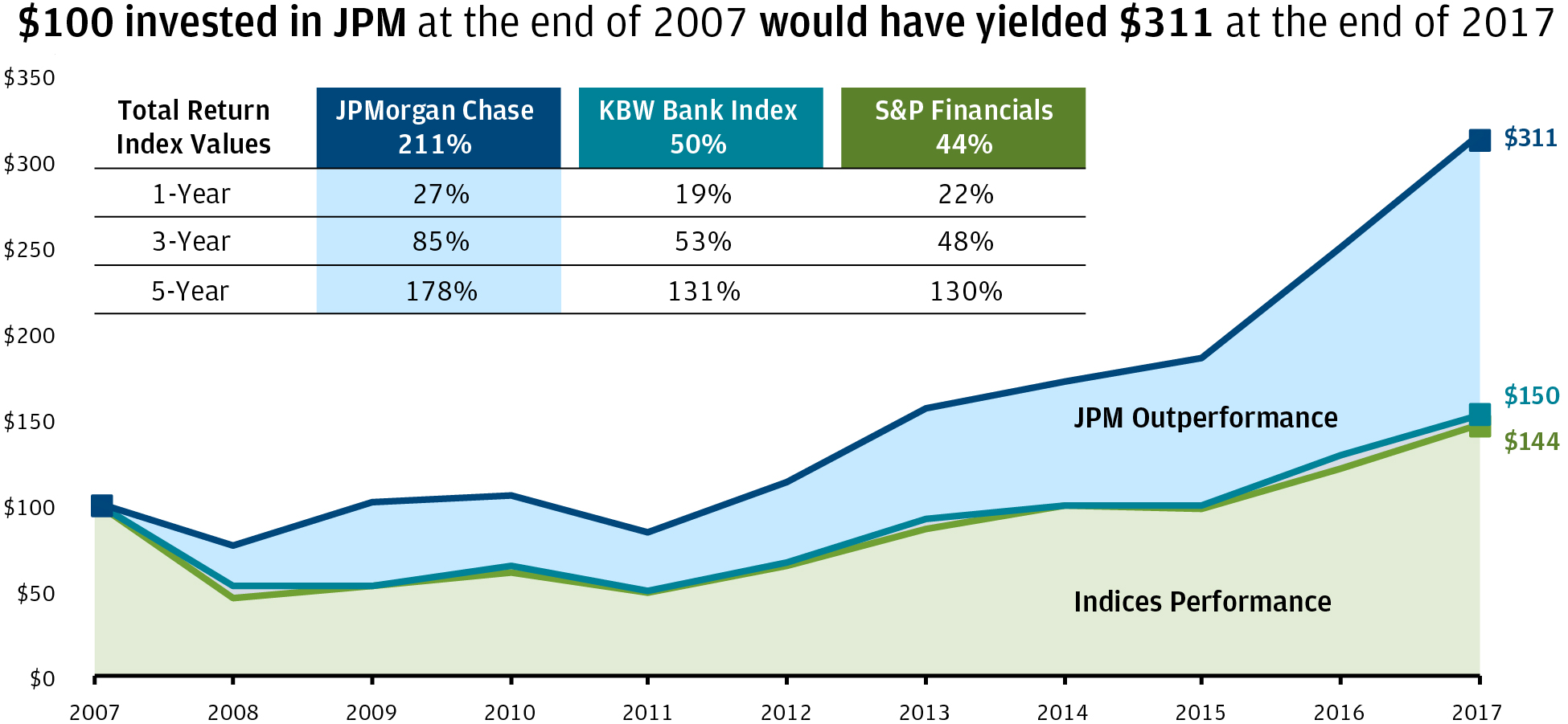
Anyway, as usual, the JP Morgan annual letter is a great read. No need to elaborate much on it, but as usual I love the charts they put in it and in the proxy. These are charts I've been following for years, even before they started to put them regularly in the reports.

Conference call
By the way, I usually listen to the JPM conference calls every quarter. There is a lot to learn from them, and when Dimon is on, he is usually pretty blunt, so fun (and educational) to listen to.

But one thing that I wonder about is the format. When you listen to some of the high-tech conference calls, what's cool is that some of them totally drop the summary and go right to Q&A. Do we really need someone to read off the highlights from each slide? I would rather that be cut and have a longer Q&A session, or have topics not covered in the slides. It seems kind of silly that someone just reads off something we all have already.

Amazon's meeting protocol is interesting. I think they spend 20 or 30 minutes reading the material (at the meeting) before they start discussing stuff. Obviously, there would be no need to have a conference call and be silent for the first 30 minutes... Maybe just release the documents 30 minutes sooner or whatever (I know they release it before the call, but just increase the time in between, maybe). Give people time to go over it so on the conference call, they can just focus on the Q&A, and maybe a short comment just highlighting important things.

But I don't know. Maybe the analyst community likes it that way as they have to sit through a bunch of these during earnings season and they like that slow time in the beginning so they can flip through the slides etc. But for others, it's a tedious section to sit through...

Bitcoin
I haven't changed my mind about bitcoin at all, and no, I haven't gone out and secretly bought some "just in case". Nope. Didn't do that and don't plan to. I continue to side with Buffett on this. And he had a good point in the interview/annual meeting: these things with no intrinsic value and where people can only make money if more people come into; people get angry when you speak out against it as they need people to come in for the price to go up.

I remember the anger and emotion when people spoke against gold too. But you never really see value investors get upset when bears talk down value stocks.


Hedge Funds
What's up with these big hedge funds?  I don't know. I am a fan of the big hedge funds, generally, but many have been doing horribly in recent years. I am especially shocked how bad Einhorn is doing, as he seems to be making the same mistake that the big funds made back in the 1997-2000 rally. If you remember, guys like Julian Robertson and Stanley Druckenmiller had trouble back then, as shorting expensive stocks and buying value didn't work for a few years back then. One would think people wouldn't repeat that mistake, and yet, Einhorn is short a bubble basket.

Anyway, his analysis is probably right, and those stocks will probably go down or be valued more realistically at some point. But the problem is you could have argued that with Amazon and Netflix for years. Who is to say it has to 'normalize' within the next twelve months? And if it doesn't, the stocks can be up another 30%, 50%, or 100%. If the market is ignoring fundamental valuation, that just means something trading at 100x P/E can just as easily go to 200x P/E. Why would you want to get in front of that!?  I don't know.  But these guys are way smarter and richer than me, so who am I to say.

Average Holding Period of Stocks
People often talk about the average holding period of stocks, and how that has been shortened dramatically. I tend to think that analysis is flawed, as many of those figures use trading volume as one of the factors. Well, with all that HFT trading going on where portfolios can turn over 100% in minutes, that sort of skews the data. Just because a bunch of quants start trading with average holding periods in micro-seconds, that doesn't really affect the rest of us who still like to own stocks for 5, 10 or 20 years.

But anyway, not a big deal.

Ian Cumming/Leucadia
I realized way after the fact that Ian Cumming passed away earlier this year. I don't go to many annual meetings, but I will never forget the last LUK annual meeting with Cumming/Steinberg. I wrote about it here.

Not long after that, Leucadia changed it's name to Jefferies Financial Group and ticker symbol back to JEF.  Oh well. I guess that reflects the reality that LUK is not really LUK anymore (and wasn't after the merger).


JPM
OK, so most of these are self-explanatory but let's look at some of the charts from the JPM 2017 annual report.

JPM is doing well against comps in terms of cost and return on tangible book.


Classic Dimon; snip from annual report:

I was recently at a senior leadership offsite meeting talking about bureaucracy. We heard bureaucracy described as “a necessary outcome of complex businesses operating in complex international and regulatory environments.” This is hogwash. Bureaucracy is a disease. Bureaucracy drives out good people, slows down decision making, kills innovation and is often the petri dish of bad politics. Large organizations, in fact all organizations, should be thought of as always slowing down and getting more bureaucratic. Therefore, leaders must continually drive for speed and accuracy to eliminate waste and kill bureaucracy. When you get in great shape, you don’t stop exercising.
Meetings. Internal meetings can be a giant waste of time and money. I am a vocal proponent of having fewer of them. If a meeting is absolutely necessary, the organizer needs to have a well-planned, focused agenda with pre-read materials sent in advance. The right people have to be in the room, and follow-up actions must be well-documented. Just as important, each meeting should only run for as long as it needs to and lead

I love these two quotes. I worked at a large company and it's so true. People tend to spend more time building and defending bureaucracies than building businesses at big places. Dimon talks about having war rooms to tackle urgent issues. Part of why that's so great is because the teams are put together for specific projects, and are presumably disbanded after the task is done.

The problem with big companies, oftentimes, is that a section or group is set up to deal with certain issues, but when those 'issues' are resolved or are no longer issues, the group or department, have to invent other reasons to keep existing. Or sometimes they don't even have to do that; the department survives with underemployed people doing nothing all day long (I have seen this). They can't shut down these divisions because there is no place for the managers to go, and they can't be demoted. With ever expanding companies, this is an issue as you have to sort of create more and more of these divisions that worthy employees can be promoted into.

There probably shouldn't even be departments/divisions at all. Teams should just exist temporarily for specific tasks and that's it. Once you create a department, it just creates incentive for the head of that department to get bigger, and of course, they will resist change when the environment changes. So ban divisions! 

But of course, that's easier said than done. I am not a manager, so it's easy for me to say! 

Moving on...


From Proxy:


a2018proxyp46totalshareholde.jpg

1 TSR assumes reinvestment of dividends


The Firm has demonstrated sustained, strong financial performance
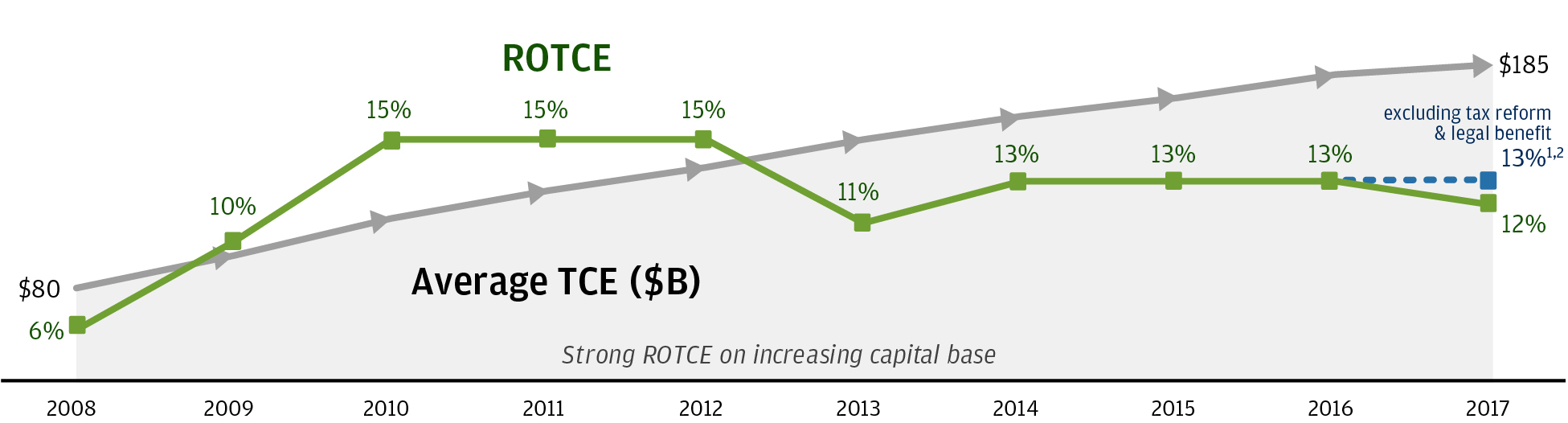
We have generated strong ROTCE over the past 10 years, while more than doubling average tangible common equity (“TCE”) from $80 billion to $185 billion, reflecting a compound annual growth rate of 10% over the period.

a2018proxychartsp45rotcea02.jpg


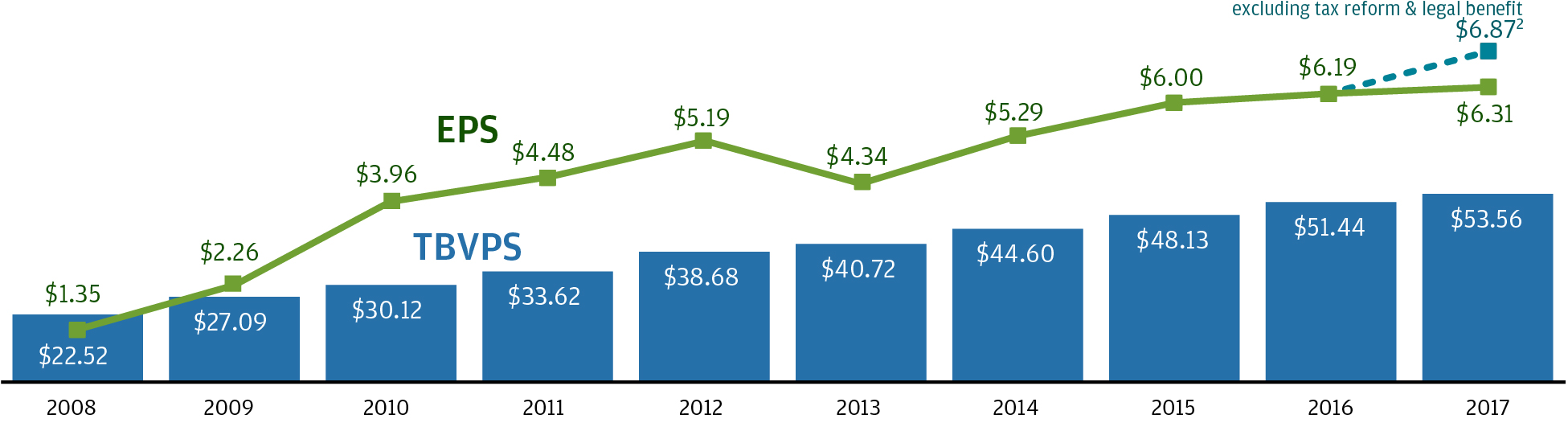
We have delivered sustained growth in both TBVPS and EPS over the past 10 years, reflecting compound annual growth rates of 10% and 19%, respectively, over the period.
a2018proxychartsptbvpsepsa03.jpg
 
ROTCE and TBVPS are each non-GAAP financial measures; for a reconciliation and further explanation, see page 115. On a comparable U.S. GAAP basis, for 2008 through 2017 respectively, return on equity (“ROE”) was 4%, 6%, 10%, 11%, 11%, 9%, 10%, 11%, 10% and 10%, and book value per share (“BVPS”) was $36.15, $39.88, $42.98, $46.52, $51.19, $53.17, $56.98, $60.46, $64.06 and $67.04.
2 
Excludes the impact of the enactment of the Tax Cuts and Jobs Act of $2.4 billion (after-tax) and of a legal benefit of $406 million (after-tax). Adjusted net income and adjusted EPS are each non-GAAP financial measures; for further explanation, see page 115.


Anyway, there is not much more to say about JPM than to say that they continue to be doing really well. Their performance since 2008 is amazing no matter how you slice it; who would have guessed this performance back in 2008 as the financial market started to melt down?

I know I spent more time talking about random stuff than JPM, but whatever... I just want to get this out now so...


Friday, January 5, 2018

Barnes & Noble (BKS)

I love books, and out of all the retailers out there in the past five, ten years, I've spent more time at BKS than anywhere else. It used to be Tower Records or J&R Music World, but now that they are all gone, BKS is one of the only other retailers that I actually enjoy being in (and, of course, some independent bookstores).

Bitcoint tangent
By the way, I don't care, really, either way about bitcoin, but did you guys notice something really interesting? The financial guys that really love bitcoin are some of the guys that either blew up or closed funds due to poor performance. The two most prominent fund manager bitcoin boosters are like that. It almost feels like they are so happy to have found their Hail Mary pass. And the most prominent guys that have good performance and didn't blow up tend to be the guys that don't like bitcoin and think it's stupid, a bubble or whatever.

Think about that for a second. Oh, and that former hedge fund guy, after bitcoin plunged put his new bitcoin hedge fund on hold (buying high and selling low?). Now wonder he didn't do well with his hedge fund; if you're going to be making decisions based on short term volatility like that, you are bound to get whipsawed and lose money.

This is interesting because we can never really understand and know everything. But it is useful to know who you can listen to and who you should ignore. Sometimes, this saves a lot of time!


Back to BKS
But what has been shocking to me, after having spent hours at BKS over the past few years, is how inefficiently run it seems to be. I am always surprised at how many employees there are walking around, or just standing there doing nothing at all. I'll call them floaters. Sometimes, desperate looking employees come up and ask me if I need any help as if they have to fill a quota on how many people they help.

Recently, even before the holiday rush, I saw two BKS employees leaning against the hand-railing playing with their phones. I went to look for some books, came back, and they were still there. Doing nothing at all; not even greeting.

And what about those 'greeters' at the top and bottom of those escalators? They remind me of the Japanese department stores in the 80's; those uniformed employees with handkerchiefs held against the escalator handrail, bowing to customers as they get on and off. Yes, BKS has the equivalent of that, in 2017!  Sometimes they stand so close to the escalator that it seems dangerous as it blocks people from getting off... I almost tripped when someone stopped right at the top of the escalator to ask a question. Last fall, I saw two people at the bottom of the escalator. Do we really need so many greeters? (and why are they all white?! Even in diverse Brooklyn, all of the employees are white, except for security guards and cleaning staff. Is BKS so old-fashioned to think that only white people have college degrees and are capable of working at BKS? This is 2017, not 1830. Come on!).

With 600+ stores, these greeters and floaters can be very costly. I can't imagine them making less than $15/hour. At 8 hours a day and 600 stores, one of those floaters (I call them that because they just float around doing nothing) can cost the chain $26 million/year. You get two of those, and that's $50 million/year.

To put this into context, the bookstore (excluding NOOK losses) had operating income of $91 million in 2017 (ended April 2017).

Of course, this may be a little too simple; not all stores will have elevator greeters etc., and operators will point to K-Mart/Sears as an example of what would happen if you cut too much in costs (and how financial people are clueless). But that's an extreme case, I think. It doesn't mean there isn't room for improvement at BKS. I know that they respect their 'booksellers' and want that community bookstore feeling with tons of friendly and knowledgeable employees to help people buy books. But it seems a little over the top and outdated to me. But I'm not a retailer so...

Technology
The other thing is that when you walk into a BKS, it's like walking into the 1970's; there is no technology anywhere. OK, there probably is in the POS system and in the back somewhere, distribution etc. But otherwise, the absolute lack of technology is kind of stunning.

Japan is not known for running efficient retailers (there are some good ones, like 7-11, Uniqlo, Muji etc.), but even in Japan there was this cool thing at a large bookstore:


It's a section where customers can search for things on their own. At BKS, when you ask someone anything, most of the time they go to a machine and do a search. I always wish they had one available for customers so we can do it ourselves. It would free up a lot in terms of labor.  Even the New York subways have huge touch-screens so you can find and get information.

Here's the other thing. I notice long BKS checkout lines and wonder why that hasn't been automated. I would think books, due to their relative uniformity, would be the easiest product to implement self-checkout.

And here's the embarrassing thing; even the public libraries have self-checkout now. I love the public libraries and don't mean to knock them, but you don't expect those quasi-governmental, non-profit organizations to be at the forefront of technology. Those self-checkouts are really great. I used to hate waiting in line to check out books at the libraries. Now it is very easy and fast. And self checkouts would mean noone trying to sell you anything! I used to always have this awkward conversation, saying no, I don't need a card, and no, I don't want you to have my email address or mailing address etc...

Also, most of the time when you see someone ask a BKS employee a question, it's "where are the cookbooks?" or some other thing. Any high school coding club could set up a touch screen floor-map of a store pretty easily. I always wondered why there isn't one of those set up by the front door, elevator and escalators. Technology is getting cheaper and cheaper. And BKS seems to be one of the best places to implement some of this stuff. They also have so much data that they would be able to use (just saving what is searched by customers would give a hint to buyers).

Pricing
The other issue is pricing. Even if you are a member and get a 10% discount, the prices on most books are still much higher than on Amazon if you are a prime member (and get free delivery). Amazon built their business on the Costco model, but BKS memberships seems like a half-hearted attempt at that. There doesn't seem to be a real economic benefit to being a BKS member (if AMZN books are still way cheaper than BKS member prices, why bother?!).

If they are going to do it, why not jack up the membership rates and lower member book prices? Why not match online prices like Best Buy? (isn't that how BBY recovered?).

Anyway, I don't know. It's really frustrating to watch this ice cube melt as I really do like BKS and don't want them to go under. But if they keep their head in the sand and try to keep up with this, they are not going to survive, and that would be a bummer for me (where would I hang out in a mall or when I have to wait for someone when they shop?!).

There are a bunch of other things, like, why is their CD/DVD section still so big, and prices so high? Do people actually buy things there? Every time I see those sections, I walk through it and I don't think I've ever seen anyone in there. I saw very few people in there during the holiday season, but usually it's empty or one or two people at most... What's up with that?

I know retailers are dangerous for private equity and activists, but it just seems like there is so much low-hanging fruit there that I can't imagine someone not making money off of gaining control.

Having said that, I don't own any (and have never owned) shares, yet. It is definitely a melting ice cube so I would be careful. But still...


Wednesday, November 22, 2017

Is Buffett Bearish?!

This is going to be a short post. It's just another one of those things that hit me in the head, like, duh! 

I read all the time that even Buffett is bearish the stock market as he is stockpiling a ton of cash. He has close to $100 billion in cash (and equivalents) on the balance sheet now. The idea is that the market is so expensive he is not finding things to buy (even though he is still buying Apple).

I took it for granted and sort of agreed, thinking that maybe he is just saving up for a really huge deal.

Still, something about this bothered me and didn't sit well. I was catching up my 10-Q's and just read BRK's 3Q and saw these giant numbers on the balance sheet, and something else struck me too, right away. Loss and LAE is up to $100 billion

And that immediately reminded me of one of my old posts where I contended that Buffett never allows cash, cash equivalents and fixed income investments to fall very far below float (old-timers will remember this). In other words, the idea that the low cost "float" is invested in stocks and operating businesses, to me, is baloney. Well, cash/capital is fungible so you can't say float isn't invested in stocks. But still, I noticed this and made a big deal out of it. Well, sort of.

Anyway, I just created a new spreadsheet going back to 1995 to see if what I said is still true (well, there is no reason the historical data would change, of course).

And here it is:

Berkshire Hathaway Cash and Fixed Income vs. Float

I shouldn't be surprised at this as I noticed this myself a few years ago. But check it out. I think people think Buffett is bearish because he used to say that he wants $20 billion of cash on the balance sheet at all times for emergency liquidity. And when cash gets over that amount, it is assumed that this is 'firepower' for the next mega-deal.

By the way, my float is not the same float as Buffett's. For simplicity, I only include Loss/LAE and unearned premiums.

Anyway, check it out. All of that cash and cash equivalent increase is basically just matching the growth in float! And to the extent that cash and cash equivalents have grown quicker than float reflects the reduction in fixed income holdings (from $36 billion in 2009 to $22 billion now), which is more of an indication of Buffett's bearishness on bonds.

The column all the way to the right is just the cash, cash equivalents and fixed income investments as a percentage of my lazily calculated float. You will see that it has been close to 100% since 1995, and I think it was true going further back. The average over this period is the 105% you see at the bottom of the table.

Conclusion
Anyway, the next time someone tells you that Buffett is bearish; just look at his cash stockpile, you can say that is more reflective of his bearishness on bonds (bond balance down, cash up), and the rest is backing up the float, as he has been doing since at least 1995.

Thursday, November 16, 2017

Bubble Watch X

The title of this post is pronounced, "Bubble Watch Ten", not "Bubble Watch Ex". So don't sound uncool in public by calling it Bubble Watch Ex...

So the bears keep saying we are in overvalued territory and we will see a huge correction soon. On the other hand, we got guys like Dan Loeb really bullish. As usual, there are a lot of smart guys on each side.

This got me thinking a lot about why the bears have got it so wrong for so long (so far... they will eventually be right! I remember (before my time, but I read about it) how Joe Granville, one of the prominent technicians of the 1970's called for a crash in the market with the Dow at 800. He was proven correct; only problem is the market crashed from 2700 to 2200, so it didn't help at all that he was short from 800. Oops.)

What bubble? 
One of the first things that come to mind when hearing all this bubble talk is that, to me, the stock market still doesn't feel at all like a bubble. OK, there may be some pockets of excess. But in general, I'm not getting the sense of a bubble. Nobody asks me about stocks. Nobody brags about their stock winnings. I am not reading about people quitting their jobs and playing the market to make a living (one of my biggest dollar wins on the short side ever was when I short Apple a while back when articles about people quitting their jobs and living off of their Apple stock gains started popping up, and they were on TV laughing at the skeptics saying that they 'just don't get it' (I am hearing/reading that now about Bitcoin, though! Japanese housewives, young people doing nothing but trading bitcoin and convinced they will never have to work again).

I don't hear any of that talk relating to the stock market. At all.

Plus, here's the other thing. People keep talking about how great the market has performed in recent years as another sign of a bubble.

But the problem with that, to me, is that a lot of that is just regaining what we lost during the crisis. If a stock tanks 50% and then doubles the next day, is the stock really overbought?  I dunno.

Check out this long term chart of the S&P 500 index. I made it a log chart so we don't go, oh my god, it's parabolic! I do believe that parabolic patterns tend to collapse, but it is useless over long time periods.


And ignore the font and background color stuff... I was just playing with Excel, which I haven't used in a long time. But due to various issues (OneDrive being one of them), I have gone back to using Microsoft products and am trying to relearn this stuff. Google sheets is great, but very buggy and frustrating to deal with.

Anyway, if you look at the 1929 bubble, the market went far above it's previous peak. Just eye-balling, the market sort of peaked out at around 10 in 1910 or so, and then rallied to 31 in 1929. That's more than a triple of the old high. Before black monday the S&P 500 rallied to 330 before crashing, and the old high was around 100, so again, the market more than tripled before tanking. During the 1999/2000 bubble, the market went to 1500. If you use the old high of 330, the market rose by 4.5 times. if you use the 1993/1994 area high of 500, the market basically tripled that.

During the Nikkei bubble, the Nikkei rose from 8,000 (the early 1980's high) to 40,000 for a five-bagger in less than a decade. But a five-bagger off the old high, not bear market low.

Where are we now? The previous high was around 1,500 for the S&P, and it's now at close to 2,600. So it hasn't even doubled. And that's a high from 17 years ago. Even using the recent pre-crisis date of 2007, that's more than 10 years.

S&P 500 Index -> 4500!
I am no expert on bubbles, but to me, this is not a bubble. I would call this stock market a bubble if we tripled the old high, or if the S&P went to 4500 or something like that.

Yeah, you heard it hear first. S&P 500 index at 4500. That's what I would call a bubble.

This is sort of consistent with my idea that the market P/E would have to get to 50x for me to be convinced that the market is in bubble territory. You can read my old posts on why that is (based on interest rates. And don't forget, I use what I consider to be 'normalized' interest rates, not current levels).

So, if you ask me, I see no bubble at this point. At all.

Real Fed Funds
The other thing that popped into my head the other day was the comment, "Never short the market with negative real fed funds rate!".  For no reason at all, this comment popped into my head and I couldn't get it out. This kept bugging me. The idea made a lot of sense, but I wasn't sure exactly where it came from. Of course, we all know not to "fight the fed", so this is a version of that, I suppose.

So when I got the time, I decided to just plot the real fed funds rate, and below is the chart:


And here's the thing. It seems like in recent history, the market has basically never gone into a serious bear market or crash with the real Fed Funds rate in negative territory. This makes logical sense. A negative FF rate means money is easy, and when money is easy, asset prices tend to go up. Shorting into that, I guess, is like fighting a tsunami with a teaspoon. Why would anyone do that?!

People keep saying that owning stocks at these levels is speculating, not investing. And yet, some of the folks who say that lose money when the market rallies, which means they are short. I don't know about you, but for me, shorting is speculating and has nothing to do whatsoever with investing.  People seem not to understand the asymmetric risk/return involved in shorting versus just owning stocks.


Static versus Dynamic Models 
Here's the other baffling thing. Much of the world seems still to be stuck in the world of static economic models. If something goes up, they must go down. If an expected return is low, the price must eventually decrease (ignoring the fact that expected return can remain low for a long, long time).

This all reminded me of an old book that confused a lot of conventional thinkers, and I think people who haven't read it should read it.  Even now:

The Alchemy of Finance

(for some reason, my Amazon bookstore is dead... oh well. I haven't looked at it in a while and now it's just totally gone. I must have missed an email or two from Amazon (probably thought it was spam and ignored it)).

30 years later, it seems like economists still think the old way and haven't really modernized. I suppose there have been new developments in behavioral economics, but I don't really see much of it when people talk about the market and economy; they all still sound like they did back in the 1980's.

But then again, I guess it doesn't really matter all that much, because most people we see or hear about are asset gatherers and spend most of their time telling people what they want to hear. They don't really care as long as they can gather assets. The ones incorporating new models and making money won't talk about it.

Anyway, I think the Soros book is very timely right now as we probably are in the midst of some sort of virtuous circle. I admit this can't go on forever and things will eventually turn.

But figuring out when it will turn is something nobody will be able to do. If I had to guess, you know what I would say. I already made a case in previous posts that a market P/E of 50x or more would indicate to me a clear and present danger of a serious bubble. And now with the added analysis of a S&P 500 index at 4500 (this is not a forecast or projection!), that to me would also indicate a serious possibility of a bubble.

This Time is NOT Different
The bears always say, "This time is not different. Bulls like to think this time it's different". Well, I dunno. I am not necessarily bullish (I am a market perma-agnostic!), but I too agree that this time is not different.

I believe the market would have to get to bubble levels before we are at risk of a serious bear market. Also, in addition to the market and P/E levels I mention above, I will now also keep an eye on the real Fed Funds rate as the market has never in the past entered a serious bear market or crash with negative FF rates.

So no, this time is not different at all. And if it's not different, we shouldn't see a big bear or crash any time soon (famous last words!  I know the market will start to tank right after I hit the "publish" button, but that's OK!).

p.s.
...Oh, and by the way, as I was cleaning out a bunch of spam in the comments section, I accidently deleted a bunch of valid comments. Sorry about that. As you know, I don't delete comments from real commentors, even if they disagree with me, criticize, or whatever...


Wednesday, September 13, 2017

Bitcoin, Marks

It's been a long time since posting last. I've gotten comments and emails wondering where I've gone. Actually, nothing has changed and it hasn't been a conscious decision to scale back here at all. I've been wanting to post.

Part of it may be that I was a little busy. I have been getting involved in volunteering here and there and sometimes it takes up a little more time than expected, and before you know it, you have no time for other stuff. Not to mention I have so many things I like to do, like coding/programming, reading etc.

The other reason for not posting much, I guess, is that things haven't really changed all that much. Maybe I'm coasting on things that I like that are doing well. I still like most of what I've talked about here and there hasn't been any reason to change anything.

Anyway, what triggered this post is another great memo from Howard Marks. If you are curious about bitcoin, or what to do about the markets (overvalued?), you should read this. Of course, most readers here probably already read it.

Howard Marks memo

This memo is fascinating because it deals with two things that I have been thinking about a lot over the past few years (OK, I haven't really thought about bitcoin all that much, actually, but I have been getting the indicators that it is indeed a bubble; people I know telling me it is going to $100,000 and are probably already calculating their net worth based on that price. At least that's what it feels like).

The Market
I haven't really changed my mind about the market at all. I've written a lot about what I think and nothing has really changed. The market is still expensive, and interest rates are still low. I still think a reasonable 'normalized' interest rate (10 year) is around 4.0%. And in that environment, stocks are still not expensive.

A lot of smart people are saying that it is way too expensive using some long term average, like the past century. Well, my view is that to use that as the norm, one would also have to assume that the average interest rate in the next century will be like the last century, and that's not at all a given. So in that sense, we can't really say what the average P/E ratio is going to be in the next century, let alone the next decade.

One argument is that low interest rates haven't helped Japanese stocks. This is an interesting thought and I may take a close look at that at some point as I did spend some time in Tokyo this summer. It is really an interesting, fascinating place. But it can also be incredibly frustrating too.

What To Do
Howard Marks writes about the options investors have at this point in an overvalued, late cycle market. He has a problem with people saying to do nothing and invest as usual. He makes a great argument but I sort of wonder about that.

Maybe it's different in fixed income versus equities; in fixed income there isn't much upside but a lot of downside. In the stock market, there is huge upside to offset huge downside.

Marks says that we do have to do something here, whether it be to lighten up, reduce return expectations, or some of the other things he lists (I agree we have to accept lower prospective returns; there is no arguing against that).

 First of all, one problem with this discussion has to do with who you are. If you are an equity fund manager, hedge fund, pension manager, asset allocator, individual investor (IRA, 401K, young person, old person) etc.

My guess is that for most people, do nothing should be fine. As Buffett said a while back, the stock market returned 10%/year in the last century, but most people who owned stocks didn't come close to that. Why? Because they kept getting in and out of the market trying to outsmart it.

When you think about that, it makes you wonder whether getting out or lighten up when you think the market is expensive is a wise decision. As I've said often before, when you look at the returns of the folks who do try to allocate capital according to forecasts, they haven't done all that well.

You can call this discipline, to get in and out according to the risk in the market. But go back to the fifties when dividend yields dipped below interest rates, which was unheard of. It's easy to imagine someone getting out of the market promising to keep discipline and go back in only when dividends yields are higher than interest rates (they would have finally gotten back in in the past few years!).

If you are young and are 100% in stocks in your IRA, that's fine. Even if you are not so young, it should be fine too as long as you understand the markets can be volatile and prospective returns are probably not going to be as high as in the past.

Keep in mind, the difference between stocks and bonds. If you are 100% invested in a great stock, say, Berkshire Hathaway, and you are worried about the market and want some spare cash just in case the market takes a dip. Well, if you are 100% invested in BRK, you are part owner of a heck of a lot of cash (on the balance sheet) and cash flow. If the market tanks, BRK will benefit. BRK will be buying. Would you not be better off letting the folks at BRK take advantage of the dip than you? Well, if the markets really tank, it's true that you might be able to get better deals (as you are probably more nimble).

But even if you stay 100% invested in BRK, they will take advantage of the dip and you will benefit.

Think about if you own a bond. If you own a BRK bond, you may not benefit on a dip in the market. BRK's bond value probably will not increase after a dip and recovery whereas the stock may very well come out bigger and stronger (maybe BRK's credit improves afterward, but probably not so much).

If you owned a high-yield bond and there is a dip, this mechanism wouldn't really work either, I don't think. A dip might hurt high-yield bonds more so you get killed, and the issuer may not come out the other side stronger as it's credit is not that strong to start with so may not be able to take advantage of a market dip to grow.

Old Greenblatt Memo
After the financial crisis, Joel Greenblatt posted a great comment on the Gotham website. He said that the mistake was not that people didn't see the crisis and didn't get out of the market in 2007. The mistake was that people owned too much stocks so that when it went down 50%, they panicked and sold out at the bottom.

He said that you should own an amount of stocks where a 50% drop won't be too upsetting to you. If you have a $100,000 stock portfolio, and a $50,000 mark-to-market loss would upset you, then you shouldn't have $100,000 in stocks. Many people invest too much assuming the bell will ring at the top so they will be able to get out.

I think the same applies today. It is not a mistake to be heavily invested (as long as you understand that markets will fluctuate, and will not return 10%/year going forward), as long as a 50% drop (and noone can predict when this will happen) won't be too upsetting to you.

If you are worried, lighten up, but lighten up because you think you might have too much exposure to stocks, not because you think you will be able to get back in at a better price later on because that probably won't happen.

Bitcoin
The most interesting part of Howard Marks' memo is about bitcoin. He was apparently bombarded by emails after his previous memo when he said that the bitcoin is a Ponzi scheme.

Of the folks supporting bitcoin is the dynamic duo from FRMO, Murray Stahl and Steven Bregman. Marks spoke at length about bitcoin with them.

Here is the FRMO letter to shareholders where they talk about crytocurrencies:

FRMO letter

If you are on the fence about bitcoin, go read this FRMO letter, and then read the Howard Marks letter. You will get a really good overview and arguments of both sides.

I have to say as much as I love technology, I don't get this one. Jamie Dimon said the other day that this was a fraud. That may be a strong word for it. I don't know if there is really any intent to defraud; these people probably actually believe it can be a real currency alternative, in which case it's not really fraud. But maybe it is fraud. Who knows.

What I don't get is that they say that central banks can print as much money as they want, but we know the supply of bitcoin going out into the future; there can't be more than that produced.

But who said that the bitcoin is going to be the only alternative cryptocurrency? The U.S. dollar has value because it is backed by the U.S. government (but nothing else), and nobody can just buy a printer and just start printing them. You can't just print your own, private dollars either. Well, I guess you can (via gift certificates, frequent flier miles, bonus points etc.).

The whole point of something valuable is it's universal acceptance. Gold, too, has a limited supply, but it has been accepted as a store of value for centuries. I have no idea where gold prices will go, but it will probably stay 'valuable' for many years to come.

But bitcoin? People lose bitcoins because they lose their USB drive that held the code, some exchange gets hacked and people lose bitcoins. If someone hacked a U.S. bank and took people's money, the FDIC would back it up. What kind of insurance or guarantee comes with bitcoin? What if one day it just doesn't work or you can't get access to it. Who do you call? What if there is a flaw in the system? Are bitcoin fans well-versed enough in the technology to figure out what went wrong?

If I woke up and my bank's website wasn't there, I can walk to a branch. If the branch isn't there, I can go to another branch, or the headquarters office. If it's not there, I can call the State bank regulator or other regulator to ask what happened and try to retrieve my money.

What's the equivalent in the bitcoin world? Who really runs it? Yes, they say nobody (or everybody). But that too is kind of scary.

China just said they are going to shut down bitcoin exchanges, and Japan announced the other day that gains and losses from bitcoin trading/investing will count as other income (I think that's what it was) and will be taxable. They said that this includes purchases with bitcoin. If you buy something with bitcoin, then you have to pay taxes on the gain.

Now, think about that for a second. How complicated is that going to be? Every time you use your bitcoin to buy something, you are going to realize a taxable gain?! What kind of payment mechanism or currency is that? That's just crazy.

OK, bitcoin supporters would argue that this will not happen because bitcoin is not trackable. There will be no 1099 or anything like that associated with it so the IRS (or the Japanese equivalent) will never know. I don't know about that. It would be surprising if they did nothing and let it stay this way; then nobody would ever pay taxes in a few years!

It's kind of incredible that so many people have jumped on the bitcoin bandwagon before the governments around the world have figured out what to do with it. Just letting it alone is a low probability scenario, I think. More likely is something like what Japan did; make it a taxable item, whatever it is. I'm kind of surprised that people aren't looking at this also as a gambling vehicle. I don't know much about gambling laws, but bitcoin as it works now sure looks like a vehicle for gambling to me.

In any case, I haven't changed my views about bitcoin. It's an odd curiousity. Kind of interesting. But without knowing how the laws will handle it, there is no way to determine if it has any real value. At least that's what I think even though there are many people smarter than me that believe in it.

If I miss this party, well, it won't be the first. If I don't understand it, I'll just stay away.

Anyway, we'll see what happens!


Thursday, May 25, 2017

Bubble Watch

Shiller said the other day that the market can go up 50% from here. OK, so I fell for it and clicked to watch the CNBC video. This was sort of a surprising comment coming from the creator of the CAPE ratio, one of the main indicators bears use to argue that the market is way overvalued.

Of course, this is not Shiller's forecast or expectation. In fact, he says that this is very unlikely, but it is possible. His point was simply that the CAPE ratio is 30x now, and in the 1990's it went up to 45x. So if that happened again, that's a 50% increase.

This is totally possible, especially now. I would not invest in the market with that expectation, of course. Actually, I would invest with the opposite expectation (when pressed, Shiller said the market is more likely to go up 50% than down 50%).

Trailing P/E
Let's put the CAPE aside for now and just look at regular trailing P/E's. Back in 1999, that went up to 30x, and in 1987, it went up to 21.4x (this is from the Shiller spreadsheet).

We keep hearing from the bears that the market is as expensive as it was during previous peaks, so we are in dangerous territory; they say we are in a bubble.

OK. That is possible.

But in previous posts, I argued that if 10 year rates stabilize at 4% over time (it's at 2.3% now), it is possible that the market P/E can average 25x during that period. Maybe the market fluctuates around that average, so the market can easily trade between 18x and 33x P/E without anything being out of whack. (Buffett also said at the recent annual meeting that if rates stay around this area, then the stock market could prove to be very undervalued at current levels.)

So we have a problem. This 18-33x P/E range puts the market in bubble territory according to the bubble experts. But we are saying here that if rates stay at 4%, that's the normal range the market should trade at.

So then, how can we tell when we are in bubble territory?

Since we are using interest rates to value the stock market, we will have to interest rate adjust our bubble levels too.

Interest Rate Adjusted Bubble P/E
So just looking back at 1999 and 1987, here are the indicators at the time:

               PE          EY       10yr
1987      21.4x      4.7%     8.8%
1999      30.0x,     3.3%     6.3%

Both 1987 and 1999 had the feel of a rubber band stretching and then snapping. You will see that the earnings yield was 4.1% lower than the 10 year rate in 1987 and 3% lower in 1999.

Right now, the P/E ratio is 23.4x, for an earnings yield of 4.3% versus the 10-year rate of 2.3%. So it's a full 2.0% higher, not lower. But even I think 2.3% on the 10 year is too low. I use 4.0% these days for what I think is a non-bubbled up, unmanipulated-by-the-Fed, sustainable, normalized rate.

Using this spread, long term rates would have to go up to 7-8% for me to worry about an overstretched rubber band snapping.

How about the stock market? How high would it have to go before I think we are really in bubble territory?

With interest rates at 2.3%, we can't deduct 3% or 4% from it to get a bubble-level earnings yield.
So we'll look at it as a ratio.  In 1987, earnings yield got to as low as 0.53x the bond rate (4.7%/8.8%) and in 1999 it got to 0.52x (3.3%/6.3%)

Using the current 2.3% 10-year rate, earnings yield would have to get to 1.2% for me to really think that maybe we are in a stock market bubble.  That comes to 83x P/E!  At that level, trust me, even I won't be talking much about long term investing, and would probably be net short with a bunch of put options too.

But wait, let's not use 2.3% because we all know that's too low. Let's use my normalized 4%.  Even with a 4% bond yield, earnings yield would have to get to 2% to be considered really bubble level.  That is a P/E ratio of 50x.   That's more than a double from here.

So for me, the market would have to actually more than double from here before I see it as really bubbly. (If you want to see what a real bubble is like, look at Bitcoin!)

Narrow Market
The other thing I hear a lot is that the market is up only because of the very few hot tech stocks like the FANG stocks. They make it sound like the market would be doing nothing without them. Maybe.

But just as a quick check, I compared the S&P 500 index (ETF: SPY) to the S&P 500 equal-weighted index (ETF: RSP); the super-large caps would have no more impact than the smallest S&P 500 companies.

Check this out:
  (The blue line is the RSP, green is SPY)

SPY versus RSP Long Term

SPY versus RSP 10 Years

SPY versus RSP 5 Years


In all of the above time periods, the RSP outperforms SPY, which I don't think would be the case if it was only a few of the super-large caps that is pulling the S&P 500 index up.

Just for fun, I looked at the S&P 500 index versus the Russell 2000 index too. If only a few super-large caps were pulling up the averages, then obviously, the S&P 500 index should be outperforming the Russell 2000 too.  The blue line is the Russell 2000, and the green line is the S&P 500 index.


S&P 500 Index versus Russell 2000 - 5 Years

S&P 500 Index versus Russell 2000 - 10 Year


Here too, I don't see the S&P 500 outperforming in a big way lead by the supers.  To the contrary, the S&P 500 index is behind the Russell in the 10 year period.

I had no idea what I would see when I put up these comparisons. Looking at them now, I am a little disappointed in active managers who claim that they are underperforming because they don't own the FANG stocks; the above shows that maybe that's not the issue.

Anyway, that's another ongoing topic here.

Conclusion
All of this stuff, I just do sometimes to satisfy my own curiosity; not to make any claims either way. I have no idea what the market will do, but I don't believe we are in a stock market bubble at all. OK, if interest rates got up to 7-8% and valuations are still here in the 23-24x P/E area (trailing basis), then yes, I would agree we have a valuation problem.

Otherwise, it would take a market P/E of 50-80x for me to think we are in a stock market bubble (and I would put on shorts and load up on puts! But even then, I wouldn't expect an immediate payoff. If the market took off like that, it would be very hard to pick the top).

Otherwise, we are just, in terms of stock market valuation, in the "zone of reasonableness", to borrow Buffett's phrase from a few years ago.

Also, keep in mind, this 50-80x P/E ratio range is not a target, of course. That's where it has to go before you convince me we are in a stock market bubble.

Also, this doesn't mean the market can't enter a bear market at any time. There was no interest rate / earnings yield rubber band in 1929 and 2007.